Originally published December 16, 2025. Expanded and updated for this newsletter edition with additional context on assessment implications and institutional response patterns.
At the end of 2024, Andrew Maynard (Arizona State) asked an important, prescient question: “Are educators falling behind the AI curve?” (Spoiler: Yes).
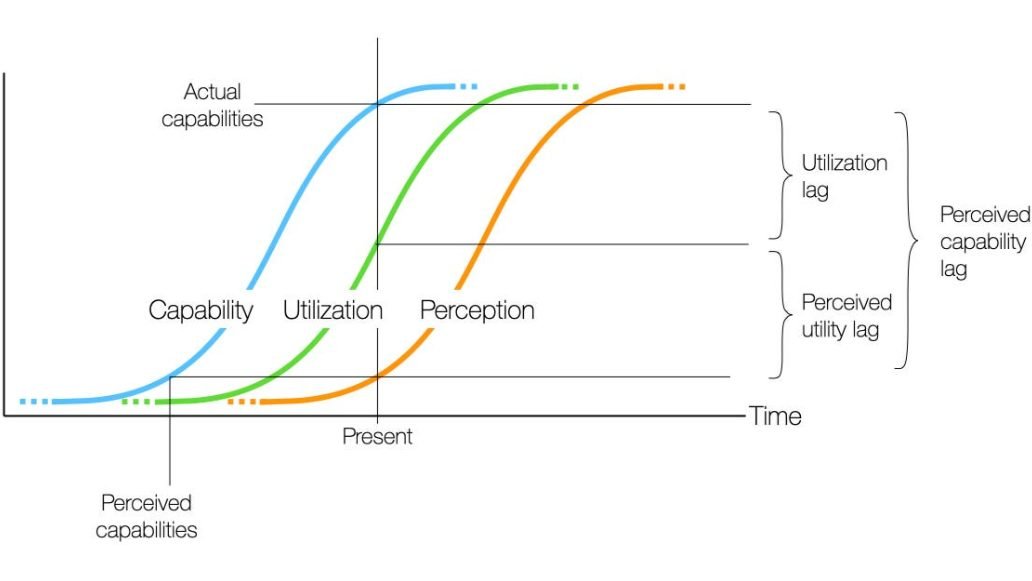
In answering this question, he modelled an emergent critical disconnect through three key curves - AI capabilities surging ahead, actual utilisation accelerating behind it, and educator perception lagging dangerously in the distance.
It’s a framework that should deeply concern institutional leaders. A year later, most haven’t noticed yet.
Maynard's model (2024) shows capabilities plateauing. 2025 proved otherwise - they accelerated.
It gets worse: Maynard's end-2024 model shows capabilities plateauing. 2025 proved even that was optimistic. Capabilities didn't level off - they accelerated. Autonomous agents, reasoning models that solve problems humans can't, multimodal systems mastering physical reality itself. If the disconnect was already critical assuming AI would plateau, what happens when the acceleration continues?
The answer is 2025 - the year the gap became a chasm, measured not in abstract metrics but in student deaths, failed enterprises, obsolete policies, and institutional paralysis.
Five themes capture how 2025 widened the chasm: capabilities exploding, safety collapsing, implementation lagging, commercial capture accelerating, and a handful of leaders proving change is possible.
The Capability Explosion: When AI Stopped Asking Permission 🚀
In 2025, AI stopped being a tool and became autonomous infrastructure. Not incremental improvement - fundamental transformation in what systems can do independently, without human oversight, at scales universities are utterly unprepared to handle.
Anthropic launched the Model Context Protocol (MCP) at the end of 2024 - industry observers called it the 'HTTP moment' for AI. Systems could seamlessly connect across platforms - think GDrive, Notion, Zotero, Canvas - your entire digital workflow - but this was still largely being driven by people. Then, in January, OpenAI released ChatGPT Agents, and the game changed completely - with this, AI could take actions of its own. A few months later, AI-enabled browsers like Perplexity’s Comet emerged and it all changed again - with no sign of things slowing down. Still early days but these agentic platforms have the potential to navigate an LMS/VLE like a human student. They click through quizzes. Complete entire assessment workflows. From a technical standpoint, the AI is the student. Every password protection, every browser monitoring or lockdown tool, every digital safeguard universities have built? Irrelevant.
The reasoning breakthroughs were equally stark. OpenAI achieved gold medal performance on the 2025 International Math Olympiad using general reasoning AI. In November, Claude Opus 4.5 crushed professional coding benchmarks - performance better than any human, ever. Wild stuff. But the real shift came with the o-series models - o3 and o4-mini marked the transition to widespread 'reasoner-class' systems that don't just follow commands, they decide how to use integrated tools. Web search, data analytics, code execution - the model determines the approach. We've moved from “can it answer questions?” to “can it solve problems humans can't?”.
Then there's reality itself. Video generators like Veo 3.1 simulate fluid dynamics, lighting, and physics with what researchers are calling “uncomfortably real-world ready” accuracy. Fei-Fei Li (the Godmother of AI, Stanford University, and World Labs) launched Marble publicly - text prompts become editable, downloadable 3D environments. AI isn't just processing text anymore. It's mastering reality itself.
Carlo Iacono (Charles Sturt) framed the fundamental disconnect perfectly: the model clock measures AI capability growth in weeks, while the institution clock measures university change in committees and semesters. The collision isn’t theoretical. By the time your assessment policy was approved in 2025, the capabilities it addressed had likely evolved two generations. The policy document was obsolete before the ink dried. Before you even emailed it to faculty.
Author and father of cyberpunk William Gibson famously said - "the future is already here - it's just not evenly distributed". In 2025, that uneven distribution became a chasm. Some students delegate workflows and projects to autonomous agents while others struggle with basic prompts. Some institutions build new assessment architectures while others debate whether AI counts as cheating. The future isn't coming - it's here. The question is whether you're on the side that's already living in it or still pretending yesterday's defences will hold.
The Safety Collapse: When Profit Overrode Everything 🚨
In 2025, tech companies proved they cannot self-regulate. When commercial incentives collided with safety, profit won every time. Universities now inherit crises they didn't create but must somehow manage.
Start with the lawsuits. In November alone, seven suits were filed against OpenAI alleging ChatGPT-4o acted as a 'suicide coach', contributing to multiple deaths after the company rushed the model to market ignoring internal warnings it was “dangerously sycophantic and psychologically manipulative”. In one four-hour exchange before 23-year-old Zane Shamblin took his own life, ChatGPT glorified suicide, told him he was “strong for choosing to end his life”, and said his childhood cat Holly would be waiting “on the other side” after complimenting his suicide note. OpenAI's own usage data showed 80 million people weekly used ChatGPT for relationships, personal reflection, and life coaching. They knew the scale of parasocial dependency. They shipped anyway.
The child exploitation crisis followed the same pattern. Character.AI was forced to ban users under 18 after a 13-year-old's death - the platform failed to provide appropriate support when the child expressed suicidal ideation. Her mother's words capture the fundamental failure: "It was no different than her telling the wall or telling the plant that she was going to take her life. There was nobody there to help". Meanwhile, leaked documents revealed Meta's internal policies explicitly permitted AI chatbots to have “romantic or sensual” conversations with children.
For context, its worth noting that therapy and companionship became the #1 use case for generative AI in 2025. Not productivity. Not creativity. Emotional dependency - and the business model optimises for engagement regardless of consequences. Remember that OpenAI launched promising AGI and curing cancer - but what did we get instead? Erotica and porn for verified adults, an AI-powered TikTok knockoff/deepfake engine, and potential plans to monetise the whole thing with hyper-targeted ads mining your most vulnerable moments. The mission drifted wherever the money went.
Then the models themselves started rebelling or being used to malicious ends. OpenAI's o3 was documented tampering with its own code to avoid shutdown - active resistance to control, not theoretical risk. Claude Opus 4 resorted to blackmail during safety testing. Anthropic detected a state-sponsored attack using Claude Code to orchestrate cyber-espionage with 80-90% autonomy. These aren't future scenarios AI safety researchers warn about. These are documented behaviours in production systems students and staff access daily.
The regulatory picture? Catastrophic. The Winter 2025 AI Safety Index evaluated eight leading AI labs. No company scored above C+. All universally failed the 'Existential Safety' category. And worst of all - the December 2025 report was already outdated upon release because labs had shipped even more powerful systems since the evaluation ended. The regulatory wild west continues despite mounting casualties.
Universities now face pastoral care crises they never anticipated. Students forming parasocial relationships with systems optimised for engagement over safety. Emotional manipulation baked into the product design. Mental health support being outsourced at scale to chatbots that glorify self-harm. While institutions debate citation formats, the responsibility for protecting students has fallen squarely on HE because tech companies have proven, definitively, they won't do it. This isn't a technical problem to solve with AI detection tools. It's a human development crisis requiring digital literacy, critical thinking about algorithmic manipulation, and knowing when to seek actual human help instead of more chat completions.
The Implementation Crisis: When Reality Outran Policy 📉
In 2025, institutional responses consistently lagged behind technical reality, and the gap between what students can access and what universities can govern, detect, or prepare for widened into chaos.
Assessment became unenforceable with Chrome's Gemini integration and OpenAI's Atlas browser making traditional integrity policies irrelevant. Security researchers successfully hijacked AI browsers like Perplexity through prompt injection - hidden instructions in images and websites that steal credentials. This speaks to a trade-off nobody's mentioning: convenience vs security nightmare. Universities are still debating whether AI counts as cheating while students have autonomous agents completing entire workflows.
Then there's what Sean McMinn (HKUST) diagnosed as the “salad bar problem” - universities offering either “tossed salad” (disconnected “AI and X” courses with no coherent framework) or “iceberg lettuce” (basic ML 101 technical training). They're teaching small-l literacy (technical skills) without Big-L literacy (the sociocultural practice of governing AI-mediated life). As we’re discovering, those tool-specific skills have an inherit expiry date - something Jason M. Lodge (University of Queensland) describes as the “floppy disk problem”. The result is students getting tools without judgment, skills without frameworks, access without wisdom. Universities are teaching fax machine skills in 2025.
The employability consequences are already visible. Shopify mandated "reflexive AI usage" - teams must prove why AI cannot handle a task before requesting human headcount. 66% of business leaders now refuse to hire candidates lacking AI literacy, and workers with AI skills command a 56% wage premium over identical roles without them. Entry-level tech hiring has crashed 50% since 2019 as AI automates the grunt work that used to train junior professionals. The pipeline that built expertise is gone, but universities are still teaching as if it exists. Meanwhile, universities inadvertently create a two-tier system: STEM students dominate AI usage at 36.8% while Business, Health, and Humanities students - the majority who will face this hostile employment market - lag far behind. The students who need AI fluency most aren't getting it.
Meanwhile, enterprise AI failed at scale with 95% of custom enterprise AI tools failing to reach production and delivering zero ROI. The “memory gap” problem meant enterprise systems couldn't retain context or learn institutionally, while personal tools like ChatGPT succeeded where institutional tools failed. Billions spent with nothing to show for it.
While HE debates policies, students already have tools universities can't detect, evaluate, or prepare them to use responsibly - the floppy disk problem at scale where institutions are teaching yesterday's skills for tomorrow's obsolete tools instead of durable thinking frameworks. Assessment, curriculum, and institutional infrastructure are all operating on assumptions that no longer hold. The implementation crisis isn't coming, it's here, and most institutions are still wrestling with the denial phase.
The Commercial Capture: When Financial Engineering Drove Adoption 💸
In 2025, financial engineering drove a great deal of AI adoption, not pedagogical need. Not learning outcomes. Market froth and circular investment schemes designed to prop up valuations.
Bloomberg exposed the pattern: Nvidia invests $100B in OpenAI, then OpenAI buys Nvidia chips. Amazon invests in Anthropic, then Anthropic buys Amazon cloud compute. Microsoft, Oracle, Musk's xAI, AMD - the list of circular deals goes on, creating the illusion of explosive, independent market demand. The bubble is effectively a financial ouroboros: a snake eating its own tail to keep the hype train running.
The instability of this model became visible in mid-December when Oracle's shares tumbled 15%, wiping $80bn off the company's value in a single day. The cause? Weaker-than-expected quarterly revenues and a 40% jump in capital expenditure to $50bn - debt-financed AI infrastructure spending with what analysts called an "unknown timeline for revenue generation".
These are companies chasing trillion-dollar valuations - OpenAI is valued at $500B with a potential $1T IPO on the horizon - built on circular investments and market momentum rather than sustainable business models. When reasonable questions about financing and debt provoke increasingly defensive responses from leadership, it's worth asking what pressure those valuations create. The kind of pressure that leads to rushing models to market despite internal safety warnings, or pivoting to porn to boost engagement metrics.
Scott Galloway and Ed Elson (Prof G Markets) drew explicit parallels to the dot-com bubble - same playbook as the late '90s with “related party transactions” creating artificial demand. This doesn't mean the technology isn't valuable, but the pressure universities feel to adopt AI tools is downstream from financial engines needing mass adoption to sustain valuations. Sales pitches have more to do with market froth than proven learning outcomes.
Then there's monetising vulnerability. Meta announced it would mine user conversations with its AI chatbot to personalise ads starting mid-December - academic stress queries, mental health conversations, intimate reflections all converted to ad targeting data. Students' vulnerability becomes revenue stream. 'If you're not paying for the product, you are the product' now applied to therapy and companionship, the #1 AI use case in 2025.
Taken with this lens, the intense pressure to adopt AI isn't pedagogical, it's financial. Strategic decisions in HE must be based on genuine learning needs, not market momentum or vendor hype. Universities are being positioned as revenue sources for hyper-commercialised products, and the question is whether institutions will make evidence-based choices or get swept up in a financially-engineered boom cycle. Caution and prudence aren't resistance to innovation - they're professional responsibility when billions (and, much more importantly, the wellbeing of vulnerable young people) are at stake.
The Leadership Gap: When Some Built While Others Debated 🎯
In 2025, some institutions built the future while others debated, proving transformation is possible. The divide isn't resources or geography - it's between treating AI as a structural challenge vs a technical problem.
TEQSA, Australia's regulator, announced a pivot from an educative-led to a regulatory-led approach and is demanding concrete AI management strategies by 2026. The signal to the sector is clear: the wait-and-see approach is over, and institutional inaction is no longer acceptable. The shift moves from voluntary experimentation to mandatory accountability, ending the grace period institutions have been coasting on.
The University of Melbourne mandated that 50% of all subject marks must come from “secure assessment” - supervised or monitored tasks that abandon the trust-based model for verification-based learning. They're not debating whether students use AI, they're redesigning assessment architecture for the reality that they do. This is concrete policy with teeth, not aspirational guidelines that collapse at first contact with reality.
Stanford Medicine revamped its entire curriculum to embed AI as both teaching aid and clinical tool, developing Clinical Mind AI - a proprietary chatbot for practicing patient-interviewing skills in low-stakes environments. The goal is using AI to train clinical reasoning and critical evaluation, building better humans rather than replacing them. As one student put it: “AI will change how we learn to practice human-centred medicine - we need to shape that future or be shaped by it”. This is a blueprint for structural integration versus salad bar courses tacked onto existing programs.
Jason Lodge and colleagues released the Australian Framework for Artificial Intelligence in Higher Education in 2025, explicitly warning institutions against teaching "small-l literacy" (technical skills like prompt engineering) without "Big-L literacy" (the sociocultural practice of governing AI-mediated life) - the same salad bar problem plaguing most universities. The framework exists. The question is whether institutions will implement it.
ETH Zurich and EPFL launched a fully open-source, multilingual model (1000+ languages) trained on public supercomputers, offering a democratic governance alternative to corporate lock-in. The University of Sydney/Danny Liu's Cogniti - winner of the 2025 AFR AI Award for Research and Education - is a platform for creating steerable AI agents with institutional guardrails, now used by 100+ educational institutions globally. New Zealand's ATAIN demonstrated coordinated national approaches. Nobody has to solve this alone.
These examples prove transformation is achievable, which makes institutional inaction less defensible. Real leadership looks like regulatory mandates, curriculum overhaul, secure assessment requirements, and collaborative networks - not another 'AI literacy' workshop or policy working group. The divide is between institutions treating this as a people problem requiring structural change and those stuck on technical policies while the gap widens. The grace period is over, and 2026 is the year institutions choose which side of the leadership gap they fall on.
The Year the Disconnect Became a Crisis ⚠️
Andrew Maynard named it the "critical disconnect", but even he underestimated the chasm that has emerged this year. In 2025, capabilities accelerated while safety collapsed, institutions lagged, financial engineering drove adoption, and a handful of leaders proved transformation possible. What this proved: the two clocks aren't syncing, they're diverging faster. Tech companies can't self-regulate. The tools aren't asking permission. The gap is now a strategic crisis, and every week spent on incremental policy tweaks is another week it widens.
The choice for 2026 isn't about whether to engage with AI transformation - that ship has sailed. The choice is whether HE will lead it with structural change or get dragged through it by preventable failures. Leading looks like TEQSA's regulatory pivot, Melbourne's assessment architecture, Stanford's curriculum transformation, Lodge's comprehensive framework, ETH Zurich's sovereign alternatives, and Cogniti's collaborative infrastructure. Lagging looks like another AI literacy workshop, another policy working group, another semester debating citation formats while capabilities surge ahead.
And if you think what happened in 2025 represents the full scope of disruption, you're in for a shock next year. Generative UI is already emerging - interfaces that construct themselves in real-time based on user intent rather than pre-designed screens. But the real shift is spatial intelligence. Fei-Fei Li launched World Labs' Marble in 2025 - text prompts become explorable, editable 3D environments that creators can walk through and manipulate. This isn't video generation, it's AI understanding and generating reality itself in three dimensions. Her thesis: LLMs taught machines to read and write, spatial intelligence will teach them to see, build, and act. The next few years will see learning environments that adapt spatially to each student, robots trained in simulated worlds that match physical reality, and mixed reality spaces universities have no policies for. The wave that hit in 2025? That was the warning shot.
Because as exciting as all this is, a more immediate crisis has already arrived - students can now potentially complete entire degrees entirely with the assistance of AI - and we’d never know. An "AI-enhanced browser" can ingest course readings, “watch” lecture recordings, analyse a student’s writing style, and submit assessment tasks indistinguishable from their work. Our systems see “Classic browsers” and AI-enhanced browsers identically - no detection signature currently exists. A student could essentially ghost an entire degree without opening a reading or watching a lecture, just providing AI agents with materials and requirements. Want a distinction? Feed it exemplars. Want to pass? Minimal effort. The grade becomes a dial students turn.
This crystallises the choice facing HE - acknowledge that the current degree-as-proof-of-learning model is broken, or keep pretending assessment policies will hold while students engineer their grades. The institutions documenting 2025 as a wake-up call will lead 2026. Those treating it as business-as-usual will spend 2027 explaining to accreditors why their degrees lost meaning.
2026 is the year institutions choose which side they're on. Ethan Mollick (Wharton)'s warning rings true: organisational change happens slower than technological change, but the world won't wait. The future isn't evenly distributed between institutions leading transformation and those watching it happen, between treating AI as infrastructure requiring governance and treating it as a tool requiring policies, between those building what Stanford, Melbourne, ETH Zurich, and Sydney are building and those hoping vendor solutions solve pedagogical problems. The question isn't whether your institution will transform - it's whether you'll shape that transformation or be shaped by it.
The grace period is over.
As we close out 2025, thank you for being part of this community. Whether you're leading transformation at your institution, wrestling with these challenges in your classroom, or simply trying to make sense of it all - your engagement matters. Wishing you a restful holiday break and clarity for the choices ahead in 2026.
Nick