Hey
Hope you had a great weekend wherever you are. Nice and chilled here - bit too much work for a weekend 🤮 but balanced out with some good meals with friends, bike rides, and long walks with the dog.
Let’s get into it:
The Pause Button and the Prospectus: Anthropic's $1tn Safety Argument | Performance or Substance?
Anthropic published a detailed account of Claude's progress toward recursive self-improvement this week - the point at which an AI can design meaningfully better versions of itself - and floated a worldwide temporary pause on AI development. The post is serious in places. The trend it documents is real - more than 80% of code merged into Anthropic's codebase is now authored by Claude. Jack Clark (Co-Founder, Anthropic) put the structural problem plainly in a recent conversation with Rory Stewart on The Rest is Politics: Leading - building more capable AI is like upgrading a power plant and accidentally producing a nuclear bomb. He said, on record, that he's scared of what he's building.
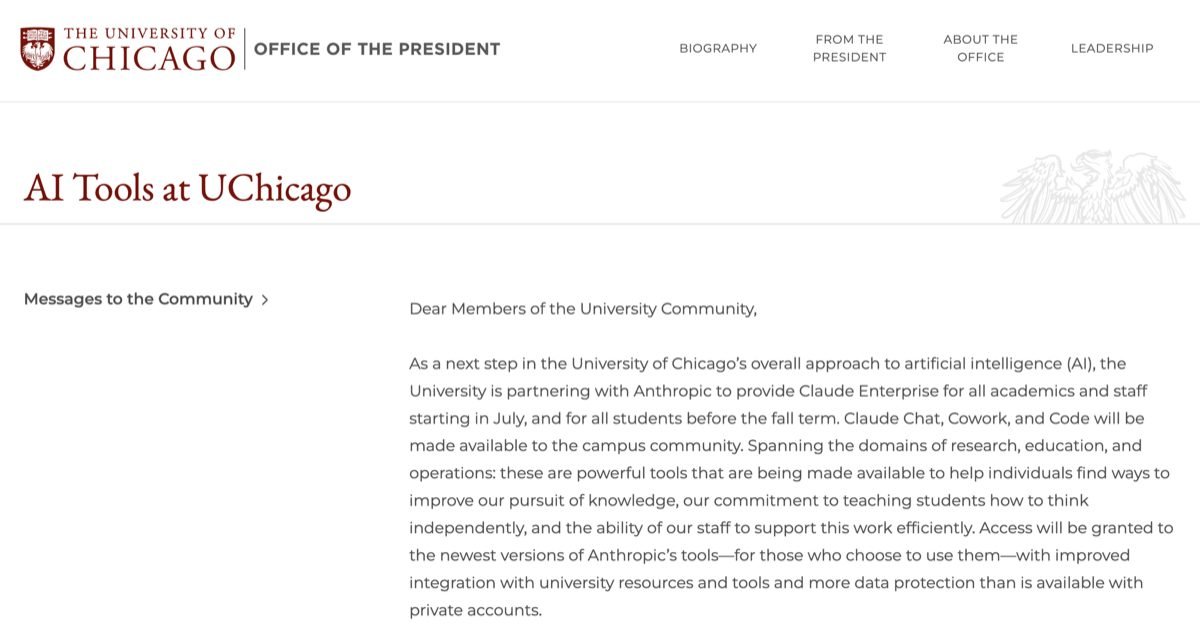
BUT - the timing is doing a lot of work. Anthropic filed for an IPO this week that could value the company at just under $1tn (for a company founded 5 short years ago 🤯). Mythos - announced two months ago as too dangerous to release - is reportedly now running inside the NSA for offensive cyber operations. UCL's Steven Murdoch notes Anthropic's definition of safety has never included opposition to offensive military use. Heidy Khlaaf called the original Mythos announcement a marketing post. None of that makes the pause proposal cynical. But a company simultaneously calling for restraint, embedding engineers in spy agencies, and filing for a trillion-dollar float is asking readers to hold a lot of contradictions at once. Love Claude but will be watching with real interest.
Token Shock: When the AI Bill Arrives and Nobody Budgeted for It | Enterprise Reality 💸
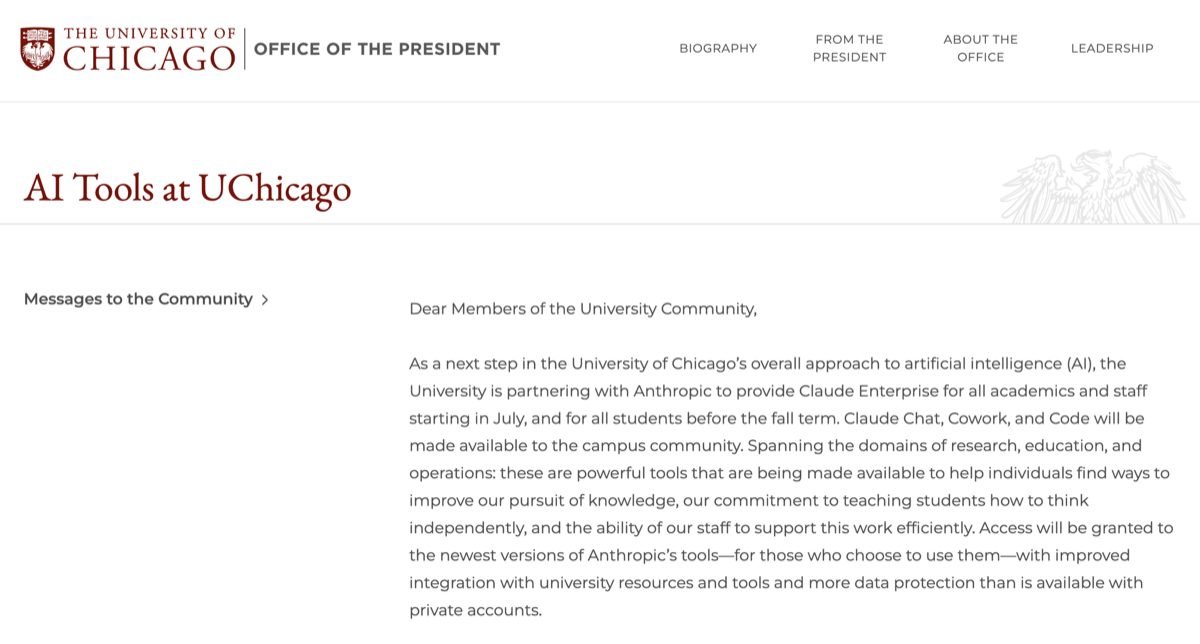
The University of Chicago announced this week it's rolling out Claude Enterprise - Chat, Cowork, and Code - to its entire community - academics, staff, and students, starting July. The language from President Alivisatos is careful and considered - skeptical, ethical, ambitious, grounded in independent thinking. Hard to argue with any of it - tho obviously I hope they’ve done the groundwork for ITS, for assessments and the like because even with just 30k students - that’s a lot that could go wrong.
Fun timing then with a recent Axios piece that shows up with the receipt no-one wanted. One unnamed company reportedly burned 500m dollars on tokens in a single month - and the scale itself is interesting. Half a billion isn't a startup miscalculating - at that scale, the company in question is probably a household name - with all the requisite infrastructure and supports in place. Staff were doing exactly what they were supposed to do - engaging AI-first with tools their organisation had signed off on. The problem was that whoever approved the licences hadn't modelled what AI-first actually looks like at scale. Enterprise AI plans are not all-you-can-eat, and even simple queries carry token costs that compound fast. Good luck Chicago! 🐻

Intelligence Leaving the Building: On-Device AI and the Energy Question Nobody's Asking | Infrastructure Shift 💻
NVIDIA announced RTX Spark at Computex this week - up to 128GB of unified memory, built explicitly for agents, no cloud, no API bill (translation - a serious computer for on-device AI). Google released Gemma 4 12B the same day - open, Apache 2.0, multimodal, 16GB of RAM (translation - a decent AI model but one you can run on a consumer-grade laptop). Same week, same signal - frontier AI is moving off someone else's server and onto your machine. The privacy framing writes itself. But the more interesting question is what this does to access economics. Enterprise API contracts have quietly shaped which institutions can afford to experiment. On-device changes that maths.

Beyond that, the energy angle is not getting enough attention - to which end I cannot recommend enough the work by the incredible Hannah Ritchie from Our World in Data (e.g., How much electricity does AI consume?). The IEA's latest puts AI at around 0.5% of global electricity in 2025 - modest at the global level, devastating at the local one. Case in point - Ireland's data centres already consume over 20% of national electricity. The US state of Virginia's over 25%. On-device shifts that burden off hyperscaler infrastructure but doesn't eliminate it. When AI leaves the cloud and lives on student laptops, nobody's counting.
![How much electricity does AI consume? [2025 summary]](/images/500-million-in-tokens-nobody-budgeted-for-it/img06.jpg)
Permission Deleted: AI Cinema and the End of the Gatekeepers | Creative Surge 🎬
This is the stuff that absolutely inspires me - the great levelling (or levelling-up if you prefer). AI users (AIrtists?) are producing cinematic quality short films - a sweeping history of Switzerland or how about an ancient Mesopotamian myth brought to life/conspiracy theory rabbit holes rendered with Hollywood production values - and it’s probably just a matter of time until people are paying to watch them. One artist. No studio. No budget meeting. No executive deciding whether your idea is commercial enough to greenlight. The tools have crossed a threshold where the question is no longer whether AI-generated video looks good. It does. The question is what happens to an industry built on the premise that you need institutional permission and institutional money to make something worth watching.
Wonderful line that captures it all for me - “AI didn't just lower the cost of making movies. It deleted the part where someone with money has to agree your idea is worth it. The wildest concept in your head and a finished cinematic version of it are now separated by effort, not permission”. For HE - think about what that does to every creative programme or learning asset built around scarcity of production access as the pedagogical constraint. The constraint is gone.
Who Gets to Define the Fraud? Universities, Media, and a Broken Detector | Academic Integrity 🎓
Kylie Moore-Gilbert (Macquarie) wrote in the Sydney Morning Herald recently that universities are committing industrial-scale fraud and advised her stepdaughter to think twice about enrolling. Some of it lands - the assessment vulnerability is real. But "probably over 90% of students are cheating" is rhetoric, not evidence, and "think twice about university" lands very differently depending on whether you have a safety net. Cath Ellis, PVC Quality and Integrity at Western Sydney University, responded - measured, substantive, worth reading. For students without networks or inherited advantage, a degree remains the most reliable lever they have. Waiting isn't neutral.

Then the twist. The Herald pulled Ellis's response after an AI detector called Pangram flagged it. Ellis had uploaded 40,000 words of her own work to an AI and used it to generate early drafts for the article - her thinking, her expertise, her writing from a decade of work on exactly this problem. There are two glaring problems here - neither of them with Ellis. First: AI detectors don't work, have never worked, and the consequences of false accusations are devastating - OpenAI shelved their own detector after six months in 2023. Second, and larger: if Ellis had pulled out her notes, her publications, her slides from a decade of conference presentations and synthesised them into a draft, nobody would have blinked. Uploading 40,000 words of your own thinking to an AI and working with what comes back is the same intellectual act in a new modality. The work is hers. That the Herald and a detector between them couldn't see that is precisely the operating environment HE is trying to navigate.

Anthropic calls for a pause and files for a trillion-dollar float. A mystery organisation burns half a billion in a month because nobody modelled what AI-first actually looks like when everyone does it at once. Frontier AI moves off the cloud and onto your laptop, off sustainability reporting and outside any accountability framework. An artist with no studio produces cinema worth paying for. An integrity officer loses her op-ed to a detector the sector already knew was broken.
The through-line isn't capability. It's who controls the conditions under which AI operates - and whether the institutions with a public-good mandate are moving fast enough to have their say in the answer.
A quick note on Adjunct Intelligence - we're on a short hiatus this week for the long weekend but there’s a bunch of fantastic conversations coming soon. Last episode Dale and I got into the moments that made us genuinely believe in the power of these machines - all killer, no filler and importantly - no hype. Worth a listen while you wait for what's coming.