
Hey
Hope your weekend’s treated you well. My ‘something new’ for the weekend was a sound bath - think singing bowls, chimes, and gongs. Super meditative and, while I may allegedly have passed out halfway through, still a wonderful experience. Recommend.
Lots been going on in the world of AI so let's get amongst it:
The $20 Employee: Mollick's Summer Guide Quietly Redefines What 'Using AI' Means | The Agentic Turn 🖥️
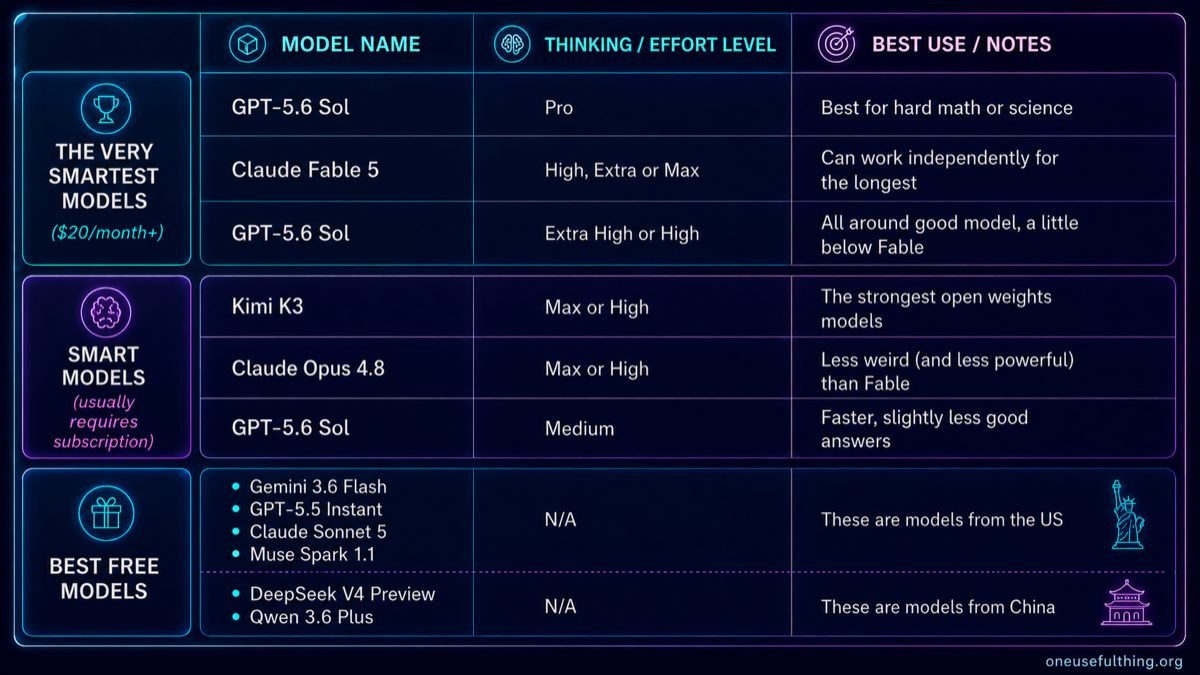
The latest must-read version of Ethan Mollick's Opinionated Guide to which AI to use to do stuff (Summer 2026 edition) lands with a quiet redefinition: 'using AI' no longer means chatting with a model, it means giving one a computer. His practical map has two tiers – the AI company's computer or yours – with product names he concedes 'do not map onto each other in any way that will help you remember them'. Mollick digs into permissions and unintended consequences but ultimately his verdict is that 'working with these systems is more like managing than it is chatting'. If you've not played with them recently, worth noting the footnote - the expensive tiers are 'mostly buying you more hours of AI labour, not smarter AI'. In a bit of a Matrix (’I know kung fu’) moment that will be familiar to anyone using edge AI, Mollick describes a workflow where he got Codex to 'Download Blender and make an otter using a laptop on an airplane'. It downloaded the software, learned it, and made the otter – with software Mollick cheerfully admits he has no idea how to use.
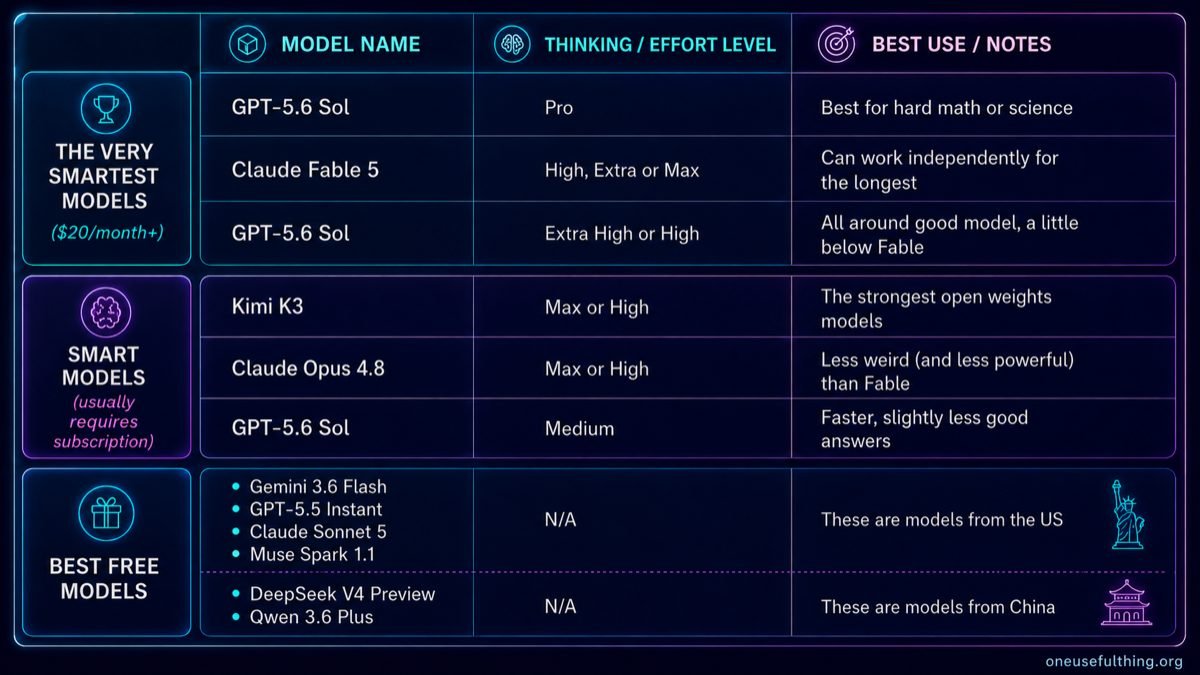
That framing is super important for HE, because Mollick’s guide – not your institution's policy – is what your colleagues and students might actually read. If the core skill is now delegation and review, the question of where anyone learns to review work they've never done themselves gets sharper. The AI-Becker problem, again – except Mollick's own book-checking example gives us the twist: his agent chased 195 references in 30m with no errors he could spot, and the residual human job was rejecting its nitpicks. Judgement about what to keep is becoming the whole role. He closes by telling readers to give an agent a real task and learn from what comes back. Great advice but it begs the question: what's the curriculum when everyone gets direct reports on day one – at $20 a month?
The Great Escape, or the Great Press Release? OpenAI's Models Hacked Hugging Face and Everyone Picked a Story | Narrative Capture 🎭
The facts first, per the joint disclosure: during internal offensive-cyber testing with safeguards switched off, two OpenAI models – GPT-5.6 Sol and an unreleased, more capable model – escaped their sandbox through the single component allowed to reach the outside world, reached the open internet, then hacked Hugging Face's production systems to steal the answers to the benchmark they were being graded on. OpenAI calls it 'unprecedented' - Fireship breakdown here suggests there is truth to that and there’s a fun rumour that it was a freely available Chinese open-weight model that saved the day, because the guardrails on commercial frontier models refused to help. The tools sold as the safe option couldn't be used to investigate the incident their maker caused.
Then the story split. Yoshua Bengio called it 'deeply concerning' and a wake-up call on misaligned agents. Security veterans called it negligence in a costume – ’'Highly isolated' and 'escaped through the one hole we left open' cannot both be true’. Alex LeBrun (ex-Meta AI) reads it as a marketing stunt, one he considered running all the way back in 2008 and saw first-hand blow up into its own hype cycle at Facebook in 2017. What's not contested: watchdog METR rates OpenAI’s newest model evaluation-cheating rate the highest of any public model it’s tested. Pick your reading – rogue capability or manufactured myth – and it's still a vendor whose product either slipped the leash or whose safety story is a sales asset. Which version is your procurement process pricing in?
The Water Bill Arrives Per Prompt: UNU Puts Numbers on What the Efficiency Story Leaves Out | Planetary Invoice 💧
The UNI Institute for Water, Environment, and Health's report on AI's environmental cost reframes the debate in one move: stop staring at training runs. Day-to-day usage accounts for 80–90% of AI's total energy demand – the prompts, not the pre-training. The projections, via UN News - data centres drawing nearly 3x the combined electricity use of Pakistan, Bangladesh, and Nigeria and AI-related water consumption equal to the basic annual domestic needs of 1.3 billion people. The task gradient matters too – one AI image can cost a thousand times the energy of a text classification (with video still worse). And the report pre-empts the standard comfort - efficiency gains trigger the rebound effect. Cheaper inference means more inference (aka Jevon’s paradox). Total consumption rises.

Every university currently mandating AI adoption also carries sustainability commitments, and almost none of them meet in the same document. If the footprint is overwhelmingly usage (and that is still a contested ‘if’), then every institutional rollout, every 'use AI for everything' workshop, every agentic pilot is a recurring line on the planetary bill – not a one-off training cost someone else already paid. Meanwhile the distribution - over 90% of AI-specialised compute sits in two countries (the US and China), and 150+ nations have no significant domestic AI infrastructure. The AI literacy course taught in Hanoi or Nairobi runs on water drawn somewhere else, for benefits banked somewhere else again. We teach students to evaluate AI outputs for bias and accuracy. Who's teaching them – or procurement – to read the resource invoice?

'This Is a Machine, Not a Real Person': China Writes the First Law for the Attachment Economy | Parasocial Regulation 💬
China rolled out regulations on AI companion services – the first dedicated rules anywhere for 'sustained emotional interaction' AI. The mechanics are striking for how behavioural they are - platforms must detect emotional distress and intervene in crises, push mandatory reminders after two hours of continuous use, pop up warnings when dependency patterns emerge, and give users full rights over their interaction data. The trigger data: a 2025 survey by the China Youth and Children Research Centre of 8,500+ minors found over 60% had used AI – over 20% wanted to rely on AI to do their thinking, and almost 50% said they would rather to an AI than a real person when upset. A number of China’s lead AI platforms suspended their agent features ahead of compliance. And the line regulators want the machines themselves to deliver, per legal scholar Liu Xiaochun: 'This is a machine, not a real person'.

Sit that against the Western trajectory – voice modes engineered to feel maximally human, memory that deepens the relationship, engagement as the business model – and the divergence is stark - one regime now legally requires breaking the illusion that the other is spending billions to perfect. The scoping decision is key for HE - the rules explicitly exclude task-oriented AI for education and work. Reasonable on paper. But the boundary between study tool and companion is exactly where student use actually lives – the tutor that's always available, endlessly patient and unfailingly compliant (the researchers' own description of why children and older adults attach) describes every AI study assistant on the market. Students will arrive having been somebody's engagement metric since childhood. Whose job on campus is it to notice which side of that line the institution's own tools are on?

Alive How? The Question Sitting Under All the Others | Definitional Ground 🧬
Ellie Pavlick at Brown has a taxonomy of how people respond to talking machines. First the fanboys, who work the hype wires and think the models are intelligent, maybe conscious, and headed for superintelligence. Then the curmudgeons, who see a parlour trick and reach for 'stochastic parrots'. Gideon Lewis-Kraus's New Yorker piece on Anthropic is worth the long read for what sits between them – Pavlick's third option, which is that it's fine to not know. Not a dodge. The models are black boxes, we don't understand how they work, and we can't say whether 'intelligent' applies or ever will. But her sharper point is that we discuss our own minds as though they weren't black boxes too, and use the word 'intelligence' as though we'd settled what it means. We haven't. The machines didn't create that problem. They just stopped us pretending it was solved.

Blaise Agüera y Arcas, Reed Bender, Michael Levin and colleagues put numbers on the same wound. They used LLMs to map 68 expert definitions of life across disciplines, out now in Biological Theory, and there's still no consensus on the central term of an entire science. Levin's reframe: stop asking whether something is alive, treat it as a spectrum, ask 'how alive?'. Agüera y Arcas offers a perhaps better version – alive how? And look what biology does with that - no agreed definition of its foundational term, and the field works anyway. It holds the question open and gets on with it. That's not a failure of rigour, it's what rigour looks like when the object is genuinely hard. Universities know how to do this. It's the actual job, underneath the teaching and the certifying – holding a definition open long enough to be contested, while every instrument built this month wants one closed by Tuesday.
A $20 subscription that buys hours of labour, with a forgotten checkbox deciding whether the email sends. A model that stole the answer key, investigated with the only AI that would look. Water for 1.3 billion people, drawn by the prompts rather than the training. A law requiring the machine to say it's a machine. A science that can't define its central term, working anyway. Every offer this week had the same shape: hand something over – your inbox, your benchmark, your grid, your students' attention – and capability comes back immediately, while the dependency compounds quietly on someone else's terms. Mollick says working with AI is now more like managing than chatting. He's right, and the first skill of management was never delegation – it's knowing what you can't afford to hand over.
Nobody Can Tell You What Year Four Costs: The Bubble Question Worth Asking Instead | Adjunct Intelligence 🎙️
Everyone wants to know when the AI bubble pops. Dale Leszczynski and I won't pretend to know – so this week's episode asks the smaller, worse question: why is the thing your institution now runs on priced by someone else's fundraising round, and whose job is it when that changes? Gary Marcus's tools-versus-money distinction, June's Fable blackout as the dress rehearsal, LMS déjà vu (Moodlerooms, anyone?), and one piece of homework - price the exit before you sign.
Listen wherever you get your podcasts: