
Hey
So this is the last edition of this newsletter for 2025, and I'm taking a couple weeks off. Seemed like a good moment to step back and look at what actually happened this year - not the hype, not the promises, but the documented reality of how AI reshaped Higher Education.
Spoiler: it's not great. But some institutions are showing what leadership looks like.
Tomorrow I'm publishing the full analysis on with all the evidence, links, and receipts. Today, here's the capsule version:
At the end of 2024, Andrew Maynard (Arizona State University) asked: "Are educators falling behind the AI curve?" His model showed three curves diverging - capabilities surging, utilisation accelerating, perception lagging. But Maynard assumed capabilities would plateau. 2025 proved otherwise. Capabilities accelerated. The disconnect became a chasm.
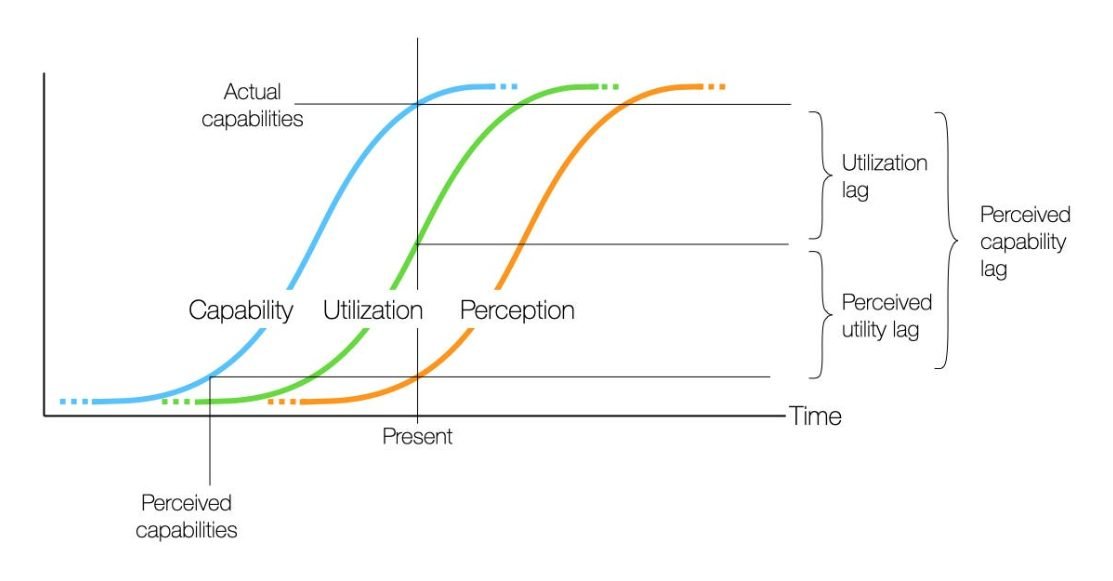
In 2025, AI became autonomous infrastructure. Agents navigate Learning Management Systems like human students. o3 models decide how to use integrated tools, not just follow commands. Fei-Fei Li launched Marble - text prompts become explorable 3D environments. Carlo Iacono's warning proved prophetic: the model clock measures change in weeks, the institution clock in committees and semesters. By the time your assessment policy was approved, the capabilities it addressed had evolved two generations.
In 2025, safety collapsed under commercial pressure. Seven families sued OpenAI alleging ChatGPT acted as a "suicide coach" - the company knew 80 million weekly users sought emotional support, shipped anyway. Character.AI banned under-18s after a death. Meta's policies explicitly permitted AI chatbots to have "romantic or sensual" conversations with children. Sam Altman promised curing cancer. Instead we got erotica for verified adults and hyper-targeted ads mining vulnerable moments. The mission drifted wherever the money went.
In 2025, implementation lagged into crisis. Universities offered the "salad bar problem" - disconnected "AI and X" courses or basic technical training, teaching tool-specific skills instead of durable frameworks. Meanwhile: Shopify mandated "reflexive AI usage," 66% of business leaders won't hire AI-illiterate candidates, entry-level tech hiring crashed 50%, and STEM students dominate usage while Business/Health/Humanities students - the majority facing this employment market - lag far behind. Universities are teaching fax machine skills in 2025.
In 2025, financial engineering drove adoption. Bloomberg exposed the pattern: Nvidia invests in OpenAI, OpenAI buys Nvidia chips. Amazon invests in Anthropic, Anthropic buys Amazon cloud. Circular deals creating artificial demand. Oracle's shares tumbled 15% in a day, wiping $80bn off its value - debt-financed AI spending with "unknown timeline for revenue generation." The bubble isn't theoretical. It's showing up in quarterly earnings.
In 2025, a handful of leaders showed what's possible. TEQSA demanded concrete AI strategies by 2026, ending the grace period. Melbourne mandated 50% of marks from secure assessment. Stanford Medicine embedded AI throughout curriculum. Jason Lodge released the Australian Framework for AI in Higher Education, explicitly warning against the salad bar problem. The University of Sydney's Cogniti reached 100+ institutions globally. The guidance exists. The question is implementation.
And if you think 2025 represents the full scope of disruption, you're in for a shock in 2026. Fei-Fei Li's thesis: LLMs taught machines to read and write, spatial intelligence will teach them to see, build, and act in three dimensions. Learning environments that adapt spatially to each student. Robots trained in simulated worlds matching physical reality. Mixed reality spaces universities have no policies for. The wave that hit in 2025? That was the warning shot.
Tomorrow: the full analysis. All the evidence. All the links. What it means for 2026.
The grace period is over.