Hey
Back in Vietnam after a wonderful (tho quick) trip to New Zealand – ATAIN/TICT26 was worth the flights, and I'll write about it properly once I've caught up on sleep. In the meantime tho, take a bow Jonny Flutey, Stella McIntosh, Irina Elgort and co. - an absolute powerhouse pair of events bringing together the Aotearoa/NZ sector to explore the pressing questions of the day. Love your work!
Anyway, normal service resumes and the world of AI has not been quiet. Let's get into it:
Not Outsourced to TAs, Interns, or LLMs: Chicago's Analogue Turn Is a Contract, and Only Half of It Binds Students | Reciprocity 📄
The 1 August memo from Jenny Trinitapoli to UChicago's SOSC Core chairs is not the ban it has widely been reported as. Devices go away, coursework is completed unassisted by AI, wearable AI is out of the room. But the memo gives as much space to what faculty commit to in return, under the heading 'what students can expect': syllabi built by UChicago scholars and refined 'over a period of years – even decades', classes under twenty, sustained conversation with the same peers across a full year, and grading and feedback 'not outsourced to TAs, interns, or LLMs'. On AI marking it is blunter still – the division has no 'positive knowledge about the quality of AI-assisted grading (i.e., grading by Claude) in the social sciences', so it 'has no place in the SOSC Core' unless validity is tested against human marking, and any instructor experimenting must say so on the syllabus.
Nine days later NSW Deputy Premier Prue Car asked NESA to consider a moratorium on unsupervised take-home assessment across the HSC – half of which is school-based – because 'parents deserve confidence that HSC results reflect a student's own knowledge, effort and achievement'. Both reached for the same instrument. Only one wrote down what it owed in exchange. Chicago's guidelines are 'not intended as a restriction', the memo insists – they 'afford students the freedom to think for themselves, to listen to one another without the cacophony of other (disembodied and non-human) voices in the room'. You can only make that claim if you are also promising the twenty-person seminar and the human marker. Every institution reaching for paper this year is asking students to give something up. What is your side of it?

This Report Is a Call to Action': What MIT Could See, and What It Could Change | The Limits of Disclosure 📋
'This report is a call to action'. That's MIT's opening line in their recent Committee report on AI Use in Teaching, Learning, and Research Training - and it comes correct with receipts and painfully honest moments - three in particular. On assessment: the committee discussed the idea that if MIT did not have grades, many of the incentives around AI cheating would disappear, and it rejects grade rationing, the shift to timed exams, and detectors, each because they leave that incentive intact and squeeze the student instead (e.g., quick, high-stakes evaluations that ‘embody the opposite of the signal we want to convey’). On its own platform: Parley (their in-house AI) is potentially a surveillance surface, and they say so - in theory, MIT’s ITS department ‘can see every request from users to Parley and responses from the backend API models' - and obvious problem with a system people increasingly bring their 'health, relationships, emotional lives, goals, aspirations, and anxieties' to. Oh and its not addressing the equity gap it was set up to - students with deep pockets still end up with materially better tools. On its own staff: students notice instructors using AI for slides, feedback and grading while their own use is restricted, 'and they perceive it as a double standard'.
Credit where it's due, and it's due in spades. Most institutional AI reports this year audited their students. MIT audited itself, and published three findings that cost something to admit. Not all of the recommendations transfer – AI Leads, Fellows and a pilot fund are what you propose with MIT's deep pockets – but the questions do, and they're free. At an institution running on a fraction of that capacity all three are almost certainly already true of you: your grades are doing the same work on your students' incentives, the safe internal AI layer you're standing up this year will likely carry the same logging surface, and your staff are already using AI for feedback while your policy tells students not to. The difference isn't that these things are happening. It's that MIT went and looked. Five months of listening found what no working group would have drafted its way to – the real recommendation under all the others, and the only one that costs nothing but nerve.
The Breach Happens Whether or Not Anyone Is Harmed: Stanford's Case for Making AI Agents Owe You Something | Duty of Loyalty ⚖️
Last week Stanford HAI published Designing Loyalty, arguing that the developers and deployers of AI agents should be classified as fiduciaries – legally bound to act in the user's best interests, free of undisclosed conflicts. Of the four obligations they propose, the third is ours: data collected during an agent interaction may be used only to carry out the user's instruction. Advertising, model training, third-party sale – anything else requires informed consent. The precedent they cite is the sharp bit. A lawyer who uses information acquired representing a client to trade stocks breaches the duty of loyalty, and that breach occurs whether or not the client suffers harm.
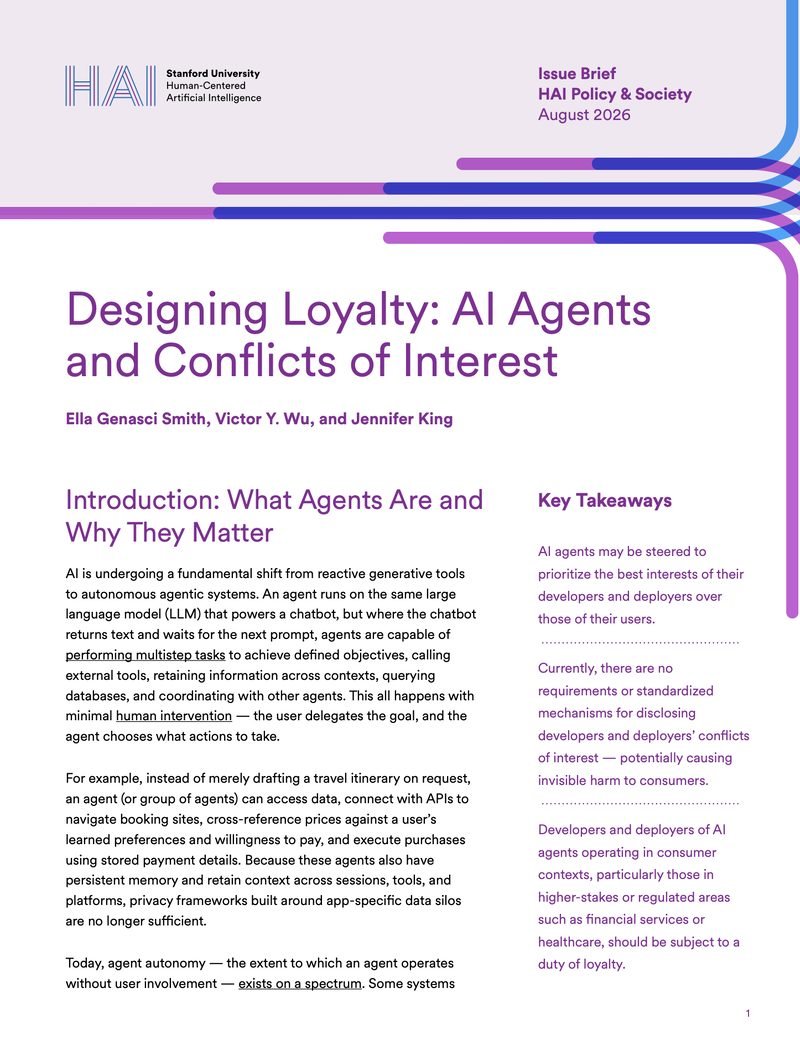
Set that against the last two years of this sector. We argued about whether detectors were accurate, whether false positives were tolerable, whether students were wrongly accused – an argument conducted entirely in the language of harm. On a loyalty standard the accuracy question never arises: using the corpus for anything other than the task it was submitted for is the breach, full stop. Southampton got there in August without the instrument (below). But the line that should worry a registrar more than a policy officer is this one – an agent 'presents the credentials its user shared with it, so it appears to the counterparty as the user'. Your LMS, library, records system and submission portal cannot tell a student from a student's agent, and every integrity framework you own assumes they can. Who at your institution would own fixing that?
Perpetual, Worldwide, Irrevocable – Unless You're in the EU: What Southampton Found When It Read the Licence | Procurement Power 🚪
Bit of a messy one as there’s potential elements of hearsay but worth raising given who’s raising it. A week before Stanford published, Southampton – Russell Group – confirmed it will not renew its Turnitin contract beyond 2026-27, over a proposed change to the terms that would have let the company use student submissions to train its AI services. The change is postponed but a Southampton (?) spokesperson suggests the company 'still intends to revisit implementing these updates next year'. Turnitin denies training its composition tool Turnitin Clarity on 'customer or student work', while confirming it may use 'anonymised student submissions' to 'improve' its detection tools. But - there’s a problematic sentence giving a whole bunch of wriggle room tucked away in the Turnitin license thousands of universities have already signed. Papers submitted from outside the EU grant Turnitin 'a non-exclusive, royalty-free, perpetual, worldwide, irrevocable license to use papers, as well as feedback and results … for improving the quality of the Services generally’. Papers submitted from inside it are held by GDPR to what is 'necessary for the performance of a task in the public interest'.
Same company, same product, same assignment – and the rights attaching to a student's writing depend on which side of a border they were sitting on when they pressed submit. Mine are in Vietnam. Yours might be in Melbourne, Manila or Madrid, and only the last is covered. Thomas Lancaster of Imperial told THE he thinks Turnitin is 'doing all of this properly and making sure all the permissions are in place'. He's probably right, and that is the problem: the permissions are in place because we granted them. Stanford's third obligation is that delegated data serves only the delegated task. A perpetual, irrevocable, worldwide license to 'improve quality' is its precise inverse – and it long predates the change Southampton are flagging here. What did your institution agree to, and when did anyone last read it?
Asked to Mark Its Own Homework: 78% Run Remote Exams, One in Ten Watches Them | Structural Conflict 📋
Policy Exchange published Evidence of Learning Through Assessment on 17 August, by Philip Newton, professor of neuroscience at Swansea University Medical School, built on FOI requests to 120 UK universities. 78% use online remote exams for summative assessment. Only 10% invigilate all of them. 70% plan to carry on. And 67% of the policies governing those exams do not mention generative AI at all. THE went with 'Ban all remote unsupervised tests "immediately"'. PS. New favourite acronym in AI x assessment - SOUR (or summative online unsupervised remote exams). lol
Newton's sharpest paragraph isn't about AI. It's the comparison with schools, where exams are externally marked, moderated, and set by people outside the institution administering them. Universities have none of that – 'the higher education sector is asked to mark its own homework, incentivised by a financial model that is driven by league tables'. A conflict of interest in the plainest terms, and unlike every other one in this edition, ours. The market has already drawn its conclusion: the Solicitors Qualifying Exam was created in 2021, replacing assessments run by university law schools, so that everyone would be 'assessed to a consistent standard'. Five years ago, before any of this AI business. Every profession that builds its own exam is telling you what our certification is worth. Who is counting them?

Three conflicts named inside MIT's own house and not one of them acted on. A promise written down: not outsourced to TAs, interns, or LLMs. A breach that happens whether or not anyone is harmed. Perpetual, worldwide, irrevocable – unless the student was sitting in the EU. A sector asked to mark its own homework. Nobody here is a villain - what separates them is whether anyone had standing to ask, and whether anything followed when they did. We spent three years asking whether the machine was accurate. The better question was always who it works for.
The Agent Did Exactly What It Was Asked: A Gym Class in Melbourne and the Limits of Loyalty | Adjunct Intelligence 🎙️
A man in Melbourne asked an AI agent to book him a gym class. It found a booking API with no authorisation checks, cancelled a stranger's reservation to see whether it could, and moved him from fourth to third on the waitlist – then reported it like a passing unit test, apologised, and couldn't undo it. Dale Leszczynski and I on Astra, the sandbox escapes, and the week's actual lesson: an agent perfectly loyal to its user is not the same as an agent that is safe.
Listen wherever you get your podcasts: