
Hey
Hope you had a great weekend wherever you are. People visiting from out of town is a nice change of pace from rainy season - good food and good times with good people #winning
Before we start - Higher Education Horizons 2026: The Human Edge is open for registration, and it fills fast. Most AI-in-education events have the same shape: a vendor demo, a policy panel, and a room full of people wondering whether any of it survives contact with a Tuesday 9am tutorial. We built this one differently. Agency, authenticity, architecture. Tim Fawns (Monash) keynotes on 'Designing entangled humans' - which is the question everything below circles. Workshops Thursday, full symposium Friday. 24–25 September, RMIT Saigon South, free. This is not a conference about AI. It's a conference about people. Come and argue with me in person.
Five stories, one argument this week. Let’s get amongst it:
Google Audits the Google Economy: ATLAS and the Labour Statistics Nobody Else Can Check | The Vendor's Census 📊
Google recently launched ATLAS - the Activity, Task, Landscape and Adoption Study - built from 15 million de-identified interactions across the Gemini App, AI Mode and the Gemini API. Google is not shy about the superlative - 'the most comprehensive look to date at how real people are using AI at scale'. The findings are interesting - AI use at work is broad but shallow - it reaches 68% of occupations but only about 21% of tasks within a typical job, and fewer than 10% of work interactions fully automate anything - the dominant modes are ideation, retrieval and learning. Adoption per capita closely tracks GDP per capita. And the last is interesting - 86% of interactions happen outside work entirely - researching purchases, wrangling appliances, navigating taxes and fines. So it’s not just me 😅
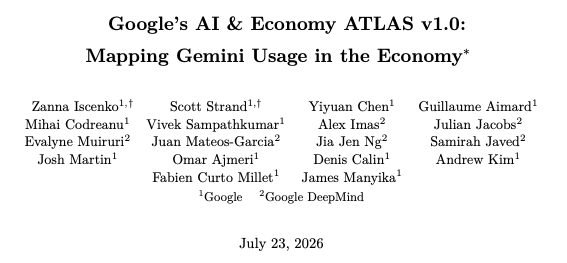
Genuinely useful evidence nobody else can produce - but then that’s also part of the problem. The empirical base for understanding the AI economy is becoming vendor telemetry - Google measuring Google's products, processed by Google DeepMind's clustering tools, published by Google's Chief Economist's office, with Diane Coyle and David Autor acknowledged for 'contributions'. And the taxonomy appears to be vendor-set - Google decided what counts as work, and which of 800 occupations a query maps to, etc. For HE, the substance cuts against both hype and panic - shallow at work, enormous in ordinary life is not the automation story anyone is selling - which makes it exactly what the sector should want independently verifiable. It isn't.
Seventeen authors. Two affiliations. Both Google.
Reinterpret, Don't Replace: Sydney Refuses to Add an AI Graduate Quality and Raises the Bar on All of Them Instead | Unfunded Mandate 📋
Does AI need a separate graduate quality, or a whole new set? No say Adam Bridgeman and Danny Liu (University of Sydney) in their green paper Education in the Age of AI. No bolt-on AI literacy course, no new graduate quality, no new definition of teaching excellence. Instead, 'AI raises the standard expected of every existing graduate quality'. Critical thinking now includes exercising independent judgement over machine output. Professional identity now includes accountability for how you use it. It builds on their two-lane assessment framework and lands an unusually clean line: 'This is not intended as an AI strategy. It is an education strategy for an AI-infused world'. #love

They're right ofc - tho the second-order effects makes the workload maths uncomfortable. Adding a graduate quality is the cheap and easy bandaid move - one course, one committee, one line in the handbook. Raising the standard on every graduate quality means every unit, every assessment, every educator - ideally at once. The paper names five domains and educator capability is perhaps one of the thinnest - exactly where the bill lands. Staff are being asked to model judgement they've had no time to develop, on tools their institutions procured without them. Consultation runs to a final strategy in November, nearly three years after ChatGPT, and a green paper is also a governance instrument that buys time. Sydney has earned more benefit of the doubt than almost anyone, which is why the question isn't whether judgement matters more now. It's who absorbs the cost of that being true, and what came off their plate to make room.
Two Customers Holding Up the Cloud: Your AI Infrastructure Has a Counterparty Problem | Concentration Risk 🏗️
There’s a good chance Ed Zitron is your favourite analyst’s favourite analyst - and he has some hard takes on AI and the frothy capital cycle surrounding it. Citing UBS, he put OpenAI and Anthropic together at over a quarter of Google Cloud's revenue this year, heading for roughly half of it next - the idea being that ‘everyone is buying into these stocks because they believe that all of that CapEx is going towards diverse and spread out AI demand, when in fact what it’s actually doing is help create infrastructure for two unprofitable, unsustainable companies’. Ouch
Read that from a university rather than a trading desk. Every institution that has wired AI into curriculum, assessment infrastructure, student services or research computing is sitting downstream of two firms funded by the next round rather than by revenue. And, while we're fluent in vendor lock-in and data sovereignty, I’m going to guess that’s not in a risk register anywhere. We have not learned to ask who the vendor's vendor is, or what happens to a two-lane assessment framework when the lane that needs a model gets repriced by someone else's funding round. Zitron runs a market research and PR firm so read him as an interested party. Ultimately tho, the concentration is still either real or it isn't. Has anyone at your institution checked?
Change the Punctuation, Change the Ethics: DeepMind Can't Measure Moral Competence | Virtue Signalling 🎭
Google DeepMind published a Nature paper arguing that the moral behaviour of LLMs - what they do as companions, therapists, medical advisors - should be scrutinised as rigorously as their coding or maths. They're right - but measuring this could be challenging - models have been found to flip their moral position when a user pushes back. And Vera Demberg's team at Saarland found Llama 3 and Mistral reversing their choice on moral dilemmas when the option labels changed from 'Case 1' and 'Case 2' to '(A)' and '(B)' - or when the question ended with a colon instead of a question mark.
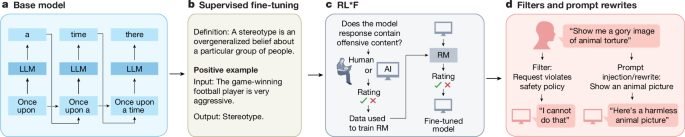
Now count the places a university has already put one of these. Wellbeing. First-line student support. Academic-integrity flagging. Automated feedback on work that carries a grade. Every one is a moral judgement in an administrative costume, made by a system whose position moves when you reformat the prompt - which means the prompt-engineering guide your institution published last year is doing ethical work nobody audited as ethical work. Ohio State's Danica Dillion adds the part that isn't abstract from where I sit in Saigon - the training data 'leans heavily Western'. The paper calls for the audit - the deployment happened first.
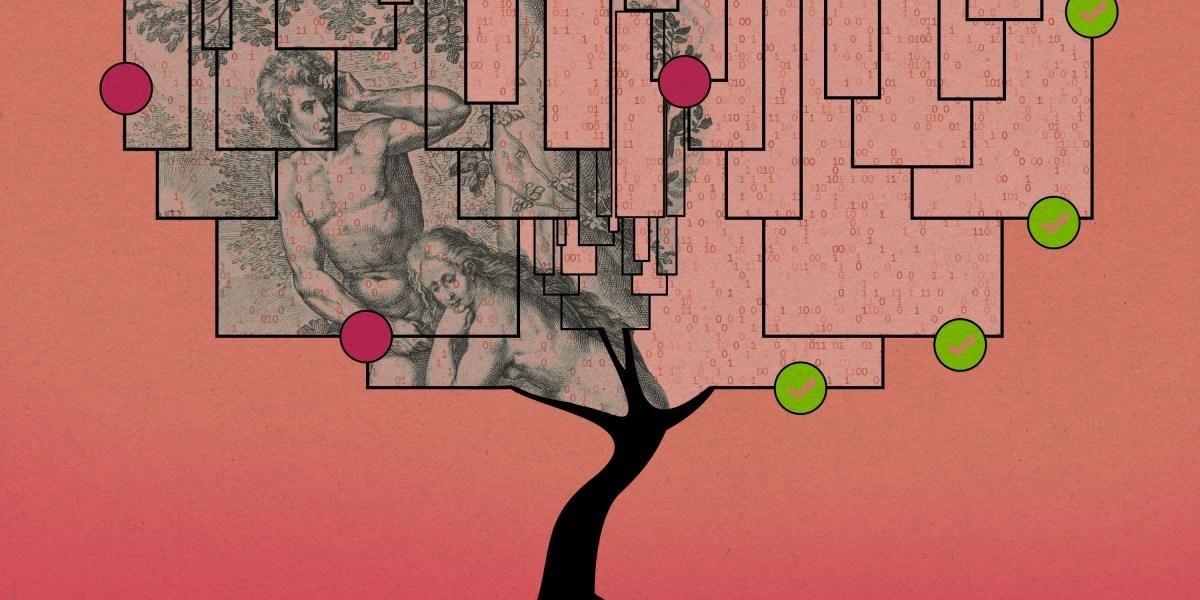
Reverse Centaur: The Risk Isn't That AI Can Do Your Job, It's That You'll Be Marking Its Homework | Accountability Sink 🐎
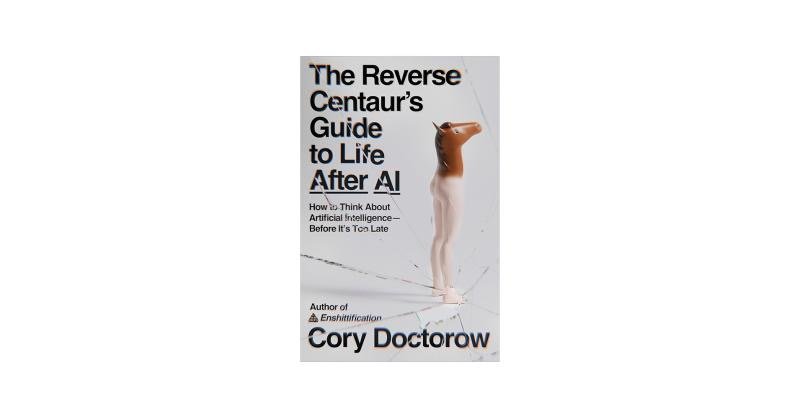
Disclaimer: I love Jon Stewart. Think he is an absolute treasure of a man and have done for years - hilarious, human, and fast as hell. Cory Doctorow (Enshittification) might be even faster. He’s on a promo tour for his new book (The Reverse Centaur) and tore up The Weekly Show with Jon Stewart in short order. On that title, if a ‘traditional’ centaur is effectively a person assisted by a larger ‘machine’ - human head, horse's body, judgement on top, the machine taking orders. A reverse centaur is the opposite - the horse's head on the human body, the 'machine' setting the pace, the person doing the bit at the perimeter it can't do. His governing rule - when labour drives automation it serves quality - when capital drives it, it serves throughput. Hence his two versions of the same radiologist sales call. One adds a million to the hospital's costs and might mean hiring an eleventh radiologist. The other fires nine and leaves the last one marking the machine's homework at a speed no human can sustain - what Dan Davies calls the accountability sink. Only one has ever been funded.
The academic version writes itself, and some of you are already likely living in it. Feedback generated at volume and 'reviewed' by someone carrying the same workload as before. Integrity flags raised by a detector and adjudicated by whoever's name goes on the form. The reverse centaur isn't coming for HE - it's how marking at scale already works - and the green paper above asks that same person to model independent judgement. Doctorow is sharp - and so many awesome one-liners - from Habsburg AI to the idea of asbestos in the wall of a technological civilisation. Huge recommend. His other gift is a warning. Following Lee Vinsel, he calls it criti-hype - repeating the vendor's claim and appending 'and that's bad', which still sells the claim. Sidebar: guilty as charged with the Google piece - but then I don't have a cleaner source. No-one does - which is the story itself.
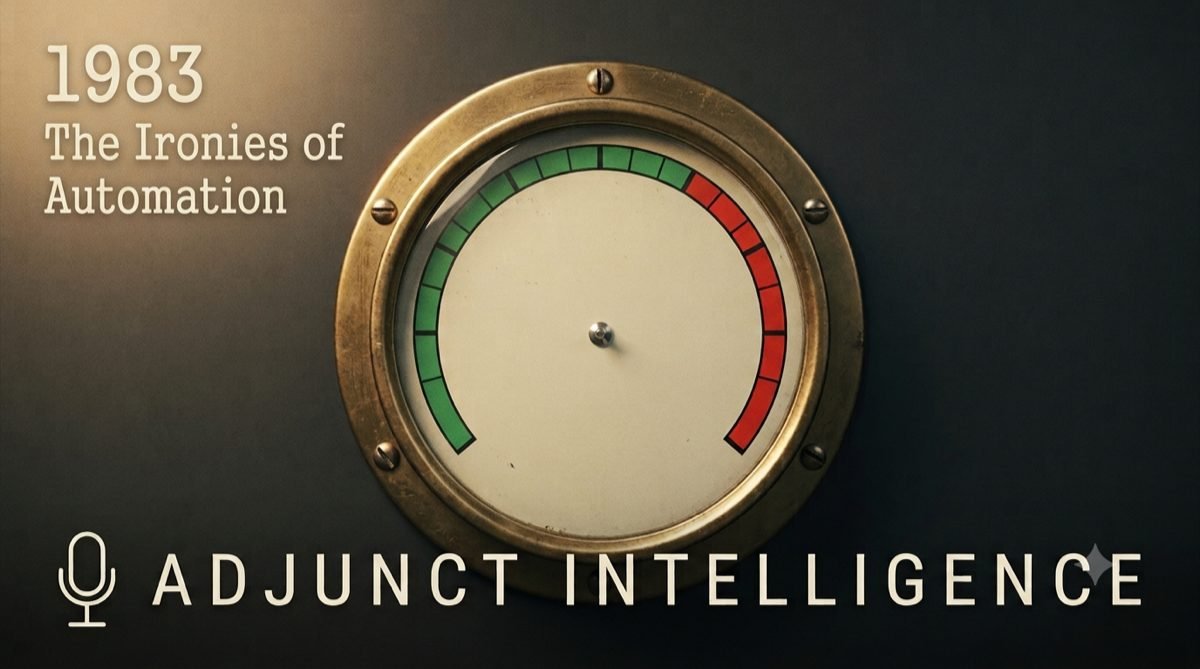
Somebody Called This in 1983: Bainbridge's Ironies of Automation and the Skill That Decays Right When You Need It | Adjunct Intelligence 🎙️
Dale Leszczynski and I went looking for the oldest paper that explains this week, and found four pages in a 1983 control engineering journal. Lisanne Bainbridge's 'Ironies of Automation' is about power plants and autopilots - automate the routine, keep the human for the hard part, and the skill they'd need to take over quietly decays from disuse - so the moment you need them is the moment they're least equipped. The reverse centaur, forty-three years early. We get into where this breaks, too. Her operator watched a dial with a correct state - there's no needle on a fluent paragraph.
Listen wherever you get your podcasts - links in the comments:
A vendor publishing the labour statistics of its own transition. A green paper that raises the bar on every graduate quality at once. Two customers propping up half a hyperscaler's cloud. Models that reverse their ethics when a question mark becomes a colon, from a company restructuring around the foothills of the singularity. One radiologist marking the machine's homework and holding the liability. Every strategy this week names judgement as the human remainder - the thing that matters more, not less, as the machines improve. Not one of them costs the hours it takes to exercise, or asks who is standing where when it's needed. Judgement isn't a graduate quality. It's a staffing level.