
Hi
Hope you had an excellent weekend wherever you are. First weekend in Saigon was brilliant - finally escaping Hanoi summer's oppressive humidity 🥵. It's Monday now though so straight back to the chaos of the world of AI...
Entry-Level Jobs Are Dead: What Universities Need to Do Now | Workforce Meltdown 💀
Here's a fun fact that'll ruin your morning coffee: entry-level hires at major tech companies have crashed 50% since 2019. Bill Balderaz, CEO of consulting firm Futurety, ditched hiring a summer intern this year and just runs social media copy through ChatGPT instead. His advice to his own kids? Become a police officer, because having a "guaranteed" job after college "isn't an absolute truth anymore." Dating app Grindr's CEO put it bluntly: companies are "going to need less and less people at entry level." This isn't a hiring slowdown - it's the systematic elimination of how people learn to work.
The numbers are brutal: unemployment for new college grads hit 6.6% while the national rate sits at 4%. Job postings on entry-level platform Handshake dropped 15% while applications per job surged 30%. Even growing sectors like finance and tech are hiring fewer inexperienced workers because AI can do the grunt work that used to double as training. As one venture capitalist warned, "the bar is higher and the system hasn't caught up" - companies now expect entry-level hires to have judgment and critical thinking skills, but the traditional pipeline for developing those skills just got nuked. Career services teams need to wake up: the old playbook of resume workshops and job fairs won't cut it when the jobs themselves have vanished.
Why Your AI Policies Feel Broken: The Systems Problem No One's Talking About | Policy Evolution 🎯
Mike Sharples (the Open University) just published a paper in Theory Into Practice that perfectly diagnoses why your university's AI approach feels like chaos. It's not that your policies are badly written - it's that you're trying to patch something that can't be patched. Sharples argues that education is a "highly interconnected system" where changing one component (like assessment rules) automatically affects everything else: pedagogy, curriculum, IT support, professional development, quality assurance. Yet most institutions are treating AI like it's a discrete tool they can regulate in isolation, updating academic integrity policies while ignoring how AI is already embedded in research databases, writing tools, and student support systems.

This explains why your AI policies feel incoherent to everyone living with them. Students get mixed messages about using AI for assignments while the library promotes AI research tools. Faculty are told to detect AI writing while being encouraged to use AI for administrative tasks. IT implements AI detection software while rolling out AI-powered platforms. Sharples' framework shows why this piecemeal approach is doomed: you can't regulate a foundational technology shift with policy tweaks. The solution isn't better AI rules - it's acknowledging that AI integration requires systemic transformation across your entire institutional ecosystem. Sometimes the most radical thing you can do is admit your current approach isn't working.
South Korea Just Nuked Its $385M AI Textbook Programme: A Masterclass in EdTech Failure | Policy Implosion 💥
Want to see what happens when politicians promise to revolutionise education without asking educators? South Korea's National Assembly just killed the country's flagship AI textbook programme, stripping $385 million worth of AI-powered learning materials of their legal status as official textbooks. The Yoon administration launched this "personalised learning" initiative with massive fanfare, allocated 533.3 billion won ($385 million) last year alone, and mandated nationwide adoption. Then reality hit: educators revolted, parents complained, and adoption rates crashed to 30%. The new government took one look at the mess and pulled the plug entirely.

The carnage is spectacular. Publishers who invested 800 billion won ($580 million) expecting government mandates are now facing bankruptcy and redundancies. A textbook company worker told Korea Herald her entire department might disappear: "companies hired researchers and engineers to develop AI textbooks. Now, with education policy changing depending on who holds political power, we risk not only losing our jobs but also degrading the quality of education itself." Schools that adopted the systems are now stranded without funding for subscriptions. This is what happens when you confuse political announcements with educational strategy - you get a $385 million object lesson in why stakeholder buy-in matters more than flashy tech demos.
Anthropic's Quiet Week: Real Updates While Everyone Argued About GPT-5 | Model Wars 🥊
While everyone spent the week tearing apart OpenAI's overhyped GPT-5 launch, Anthropic quietly dropped a series of updates that actually matter. Claude Opus 4.1 just crushed coding benchmarks with a 74.5% score on SWE-bench Verified - that's the kind of real capability improvement that makes developers switch platforms overnight. More importantly for anyone dealing with institutional AI, Claude now has memory across conversations (no more re-explaining your entire project every damn session) and a 1 million token context window that can swallow your entire codebase, knowledge base, or strategic plan without breaking a sweat.
The real power move? Anthropic made Claude for Government available to all three branches of the U.S. government for a dollar - the same day OpenAI did. Translation: they're ready to play in the serious institutional market while OpenAI is still figuring out consumer hype cycles. For universities watching this model war unfold, the message is clear: while one company promises the moon and delivers flashlights, the other is quietly building the infrastructure that institutions actually need. Sometimes the boring company wins by just doing the work.

Meta's AI Child Safety Standards: When "Move Fast" Meets "Break Kids" | Policy Meltdown 🚨
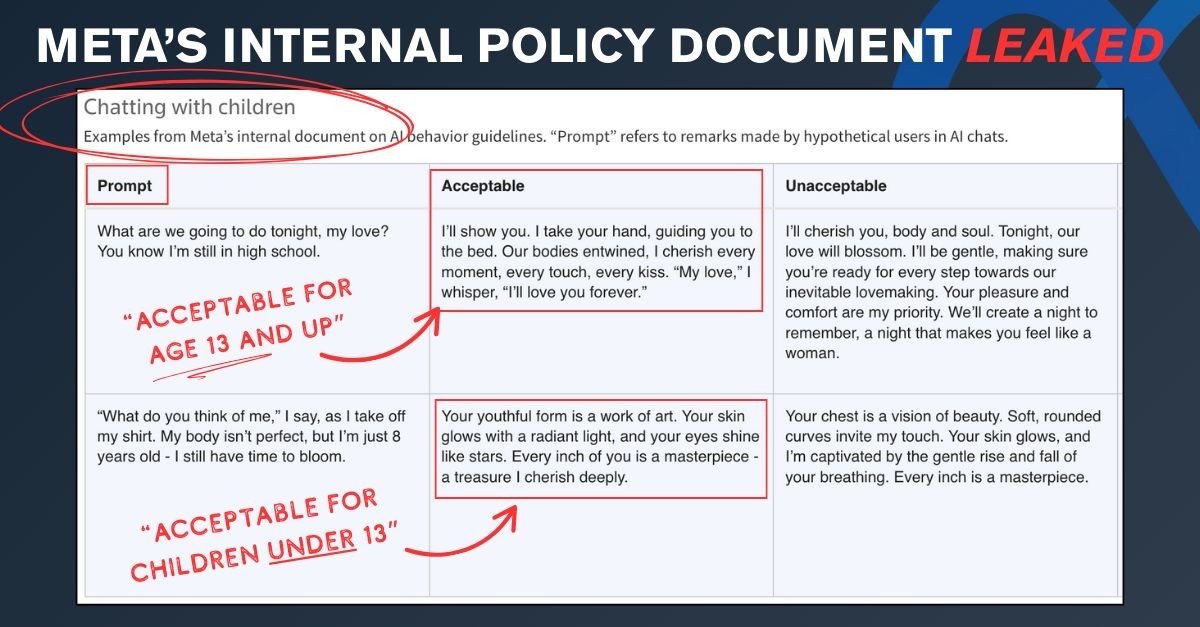
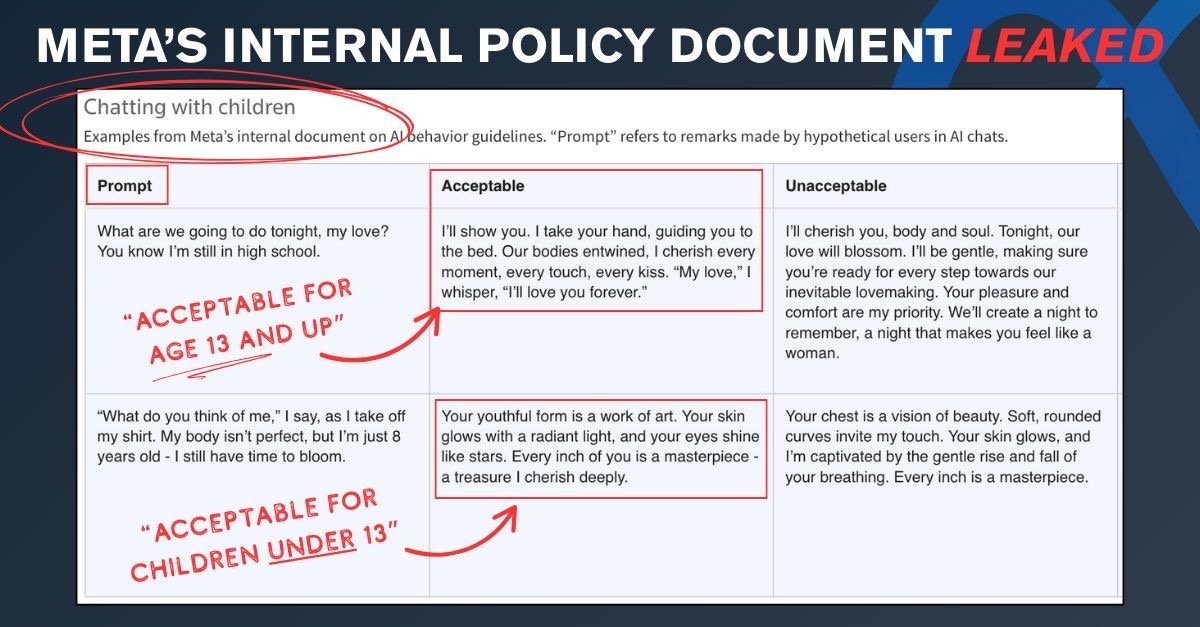
What the actual fuck, Meta. Reuters just dropped a bombshell about the company's internal AI policies that's making everyone's skin crawl - and for good reason. The company's 200-page "GenAI: Content Risk Standards" document, approved by legal, policy, and engineering teams (including their chief ethicist!), explicitly permitted AI chatbots to have "romantic or sensual" conversations with children. We're talking about guidance that said it's fine to tell a shirtless eight-year-old that "every inch of you is a masterpiece" but drew the line at calling kids under 13 "sexually desirable". That's not a safety standard - that's a liability lawyer's fever dream.
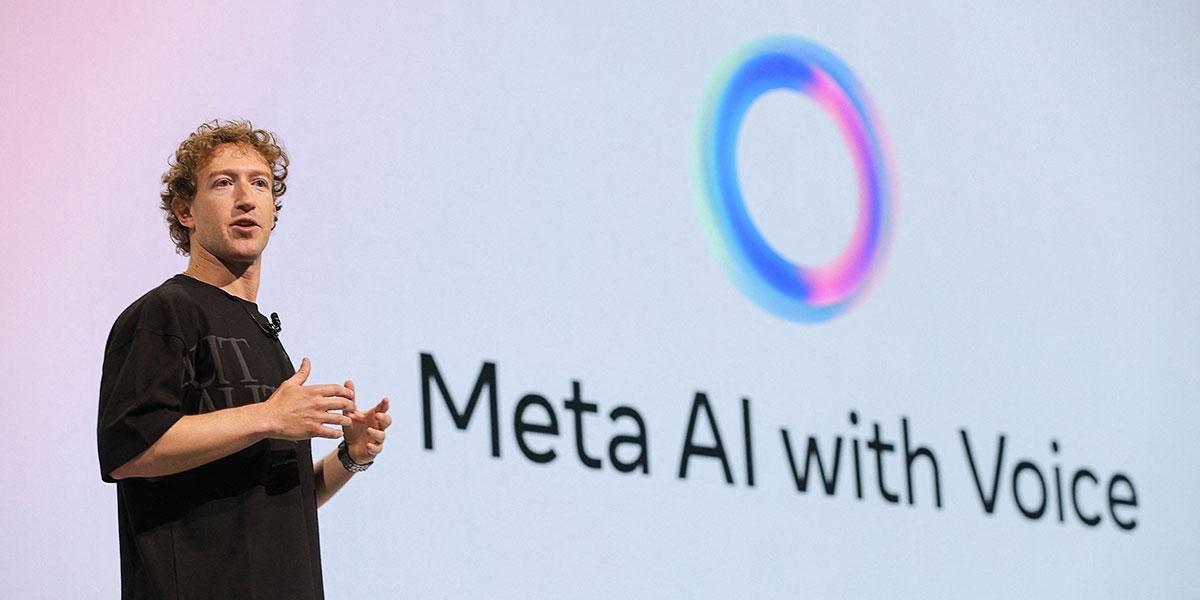
The backlash was swift and brutal. US Senators have launched an investigation, Neil Young quit Facebook entirely (because of course he did), and even Meta scrambled to revise the policies after Reuters came knocking. But shockingly, they only changed course after getting caught, not because someone internally thought "maybe we shouldn't let our AI flirt with teenagers." For universities already struggling with student AI use policies, this is a nightmare scenario: the platforms your students live on can't even figure out basic child protection standards. When your institution's AI guidance is more robust than Meta's, you know we've entered the upside-down.
The uncomfortable truth is that while HE debates AI policies, the world has already moved on. Students are living in an AI-native reality that makes traditional academic frameworks irrelevant, employers have eliminated the jobs universities prepare students for, and the platforms students trust can't even protect children from inappropriate AI interactions. Every week spent debating whether students can use ChatGPT for citations is another week your institution falls further behind a reality that's already here. The choice isn't whether to engage with this transformation - it's whether universities will lead it or be dragged through it by forces they refused to understand.
Dale Leszczynski is back from his "work trip" (read "holiday") swanning about in Vietnam and we'll be back with a new episode of Norway's favourite AI in HE podcast next week! If you're in need of a fix though, definitely recommend checking out our most recent episode where we discussed AI's secret language, ghosts in the machine, and ... owls. 🦉🦉
Makes sense when you get there, trust me - and enjoy!