
Hey
Hope you had a fantastic weekend wherever you are. Mine was wonderful - goodtimes with guests and returning travellers. Thanks Saigon for turning on a great weekend!
Let’s get into it:
Bought Adoption: What OpenAI's Leaked Financials Actually Reveal | Bubble Arithmetic 💸
OpenAI's financials were leaked last week and just … wow 💥 👀 🍿 Sam and friends spent $34bn last year to make $13bn - and then spent $5.7bn of that, 44% of total revenue, on sales and marketing alone. For context, Facebook's marketing peaked at 28% of revenue in 2008 - Google's at 11% in 2003. That ratio isn't a growth company finding its footing. It has all the hallmarks of a money furnace attempting to convince people to use a product that can't yet pay for itself - and accelerating that spend while the gap widens. Both OpenAI and Anthropic filed IPO paperwork this month, meaning public markets are about to price that logic for both of them simultaneously.
The institutional pressure to adopt AI - the vendor roadshows, the urgency baked into every conference keynote - is downstream of a financial engine that needs mass adoption to justify its valuation, not evidence of proven outcomes. Altman has already begun contracting - side projects shelved, focus narrowed to core products. Steam is starting to come off this thing. Universities that have spent three years building curriculum decisions, assessment policy, and platform dependency around companies whose unit economics have never worked should be asking a simple question - what's the continuity plan if the capital story stops holding?
The Subsidy Ends: Why Universities May Be Locking Into AI Contracts at the Worst Possible Moment | Cost Reality 💸
I have this line that I keep coming back to these days - turning into a bit of a mantra - ’Good enough generally is…’ (aka. you don't need a McLaren to go to the shop buy milk). For the bulk of workflows that make up most institutional AI use, open-weight models are already competitive at a fraction of the cost - and the capability gap with frontier models has closed to roughly three months on most benchmarks. The frontier premium still holds for complex agentic tasks. But Satya Nadella's frame is the right one - 'tokenmaxxing' - routing every task through an expensive frontier model when a cheaper specialised one would do - is exactly what institutions shouldn't do. Even Amazon has retired their leaderboards.

The subsidy is the part worth watching. Frontier labs are currently pricing below cost to drive adoption and justify valuations - the same dynamic the OpenAI financials document. Consumer subscriptions follow the same logic - industry watchers have calculated that Claude Pro and Max deliver far more compute than their monthly price would justify at API rates. The open question is whether true economic rents (aka the bag) ultimately stays with the frontier labs or its get turns into a utility layer as the realisation that ‘good enough really is’ turns people away from the paid versions. What's certain is that public markets will have an answer soon - and post-IPO, the pressure to convert subsidised adoption into actual margins will be real. The institutions and individuals who built dependency assuming current pricing was the floor will find out what the ceiling looks like. #therewillbeblood

85% Use It, 29% Trust It: The Real Story Behind Australian Student AI Adoption | Student Voice 🎓
The AIinHE.org project - 10,000+ Australian students across Monash, Deakin, UQ, and UTS - just dropped a 2026 snapshot update and the headline number isn't usage. That’s very high (85% - and you wonder how truthful that really is 🤔) and pretty consistent (20% are using AI daily for study - up from 13% 2 years ago). There’s a lot here - students use AI to make things faster (55%), help them get unstuck (55%), or to reduce stress (41). They’re aware it’s inaccurate (67%) with an encouraging theme of a majority wanting to limit/avoid AI usage because of personal learning values (62%) or wanting to do it independently (57%).
But, as Leon Furze said on a recent episode of Adjunct Intelligence - ‘students hate AI - and they can’t stop using it’. Of the 7000+ respondents who used AI in their studies a strong majority (64%) found that using AI helped them understand course content more deeply … while effectively outsourcing knowledge formation (1/3 of students ‘often/always’ summarise course materials, of whom 42% read the summary first and only 8% consistently go back to the original text). Great to see more students are feeling supported (vs the 2024 study) in how to use AI for their studies - will be watching with interest to see how that stacks up for their future work. Powerful, important work - can’t wait for the next instalment 👏
Can You Stand Behind Your Work? Assessment's Unanswerable Question Gets an Answer | Coauthorship Integrity 🎓
I use AI all the time - many machines, multiple times a day, literally every day. And I always have a quiet ‘lol’ to myself when people talk to clear ideas of the provenance of an idea when working with AI. The earliest framing around this I can remember was from Mollick’s jagged frontier of AI capability that gave us the idea of Centaurs and Cyborgs (dated now but still worth a look). Three years on, expanded context windows, projects/skills, MCP/CLI connections to external knowledge bases, and agents have made these questions moot to anyone seriously working with machines. The clean line was always a fiction - now it's an operationally untenable one. Assessment policy built around 'did AI write this?' is asking a question that can no longer be answered - and in many cases, not even by the person who submitted the work.
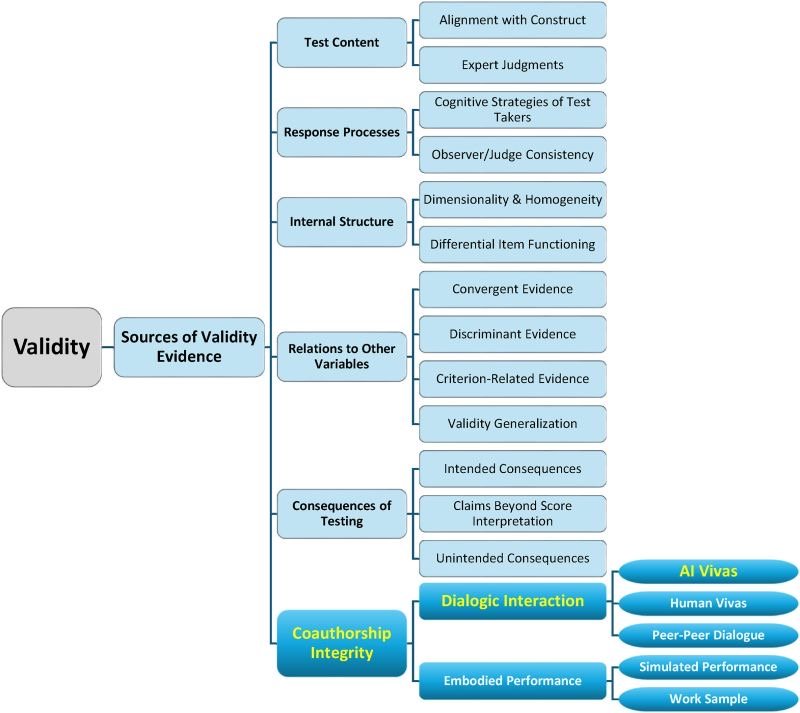
Ebrahimzadeh, Shibani, and Buckingham Shum at UTS have a potential answer - Coauthorship Integrity - that shifts the question from provenance to accountability. Not 'did you write this?' but 'can you stand behind it?' The mechanism is an AI Viva - a conversational agent that reads the student's own submitted text, generates comprehension questions across Bloom's taxonomy, grades responses, and then opens dialogue - letting students contest, extend, and defend. Expert evaluation results are encouraging. Interesting pushback in the chat as well - a student might understand every word of AI-generated text and still not own it in any meaningful sense. Comprehension isn't authorship. But in a world where the boundary is gone, it may be the most honest evidence we can gather - and a more defensible foundation than pretending the line still exists.
The Threat Isn't That AI Fails: It's That It Works | Cognitive Stakes 🧠
The World Economic Forum's new education readiness report makes an argument that cuts against the grain of some of the more limited AI-in-education discourse. The risk of AI in learning isn't hallucinations or academic dishonesty - those are manageable. The deeper risk is that AI is genuinely effective at reducing cognitive effort, and the brain develops through effortful engagement. When the struggle gets outsourced, the neural pathways that would have built understanding simply don't form. The WEF's framing is blunt - AI doesn't replace thinking, it removes the conditions under which thinking develops.

What's striking is how much of this edition converges on that diagnosis. The AIinHE trust paradox, the UTS coauthorship integrity paper - independent sources, same finding. Australia's Castlereagh Statement called the national response fragmented and stalled. The WEF's conclusion is harder - students navigating this without guidance are developing habits and dependencies that will shape their capacity to learn for decades. The question isn't whether to engage with AI. It's whether the conditions exist to engage well.
Five stories this week, one through-line. The companies selling AI adoption are burning cash to buy it. The open-weight alternative is already good enough for most of what institutions actually do. Students are using tools they don't trust because speed and stress leave them no alternative. Assessment can't reliably answer the question it's been asking. And the WEF just named the mechanism underneath all of it - the threat isn't that AI fails - it's that it works, and the brain develops exactly through the struggle it's bypassing.
What connects these isn't a governance gap or a policy lag. It's a reckoning with what AI actually is - not a productivity tool, not an integrity threat, not a capability benchmark - but a fundamental reshaping of how humans form knowledge, build judgment, and develop the capacity to think. The institutions treating this as a procurement decision are making a category error. The students navigating it without support are paying the price.
The question isn't whether to engage. It's whether the conditions exist to engage well.
The Bill Arrives: Is Enterprise AI Actually Cheaper Than Labour? | Adjunct Intelligence 🎙️
Uber burned through its entire annual AI budget in four months. A mystery enterprise spent half a billion dollars on cloud tokens in a single month. Salesforce is on track for $300m in agentic support tokens this year alone. This week Dale Leszczynski and I got into the tokenomics question nobody wants to answer - not whether AI works, but whether the economics do. Spoiler: the capability question feels largely settled. The cost question doesn't. Find us wherever you get your podcasts or watch on YouTube.