Hey
Hope you’re well and had a good weekend wherever it found you. Me, I’m just back from a wonderful week in New Zealand. Fantastic times catching up with family, enjoying incredible food and drink, and great summer weather. That said, missed my Saigon-based fam enormously while I was away - so good to be back! 🤩
Things have been busy in the world of AI this last week so let’s get amongst it:
AI's Pioneers Declare LLMs a Dead-End, Pivot to World Models: The Goalposts Move Again | Hype Cycles 🎯
2026 might mark a sharp turn downward into the trough of disillusionment part of the hype cycle with another Turing Award winner (Demis Hassabis - Founder, Google DeepMind) declaring LLMs like those underpinning current edge AI models a dead-end for future progress this week. The next frontier? Reportedly it’s World models like FeiFei Li’s Marble, etc. Great commentary on this re. LLM hype - they felt like a shortcut, like scaling might work without hard engineering, creating an "illusion of intelligence by means of scaling a quite simple concept to an absurd degree”.
So what? for HE
It's an interesting evolution of the space but might not change things too much - for now. After all, Yann LeCun (Meta’s ex-AI Chief, also a Turing award winner)'s been arguing this for years - humans learn primarily through observation (think kids processing millions of visual examples before language), not text prediction - and he’s recent put his money where his mouth is - leaving Meta and kicking off a new venture (AMI Labs). Whether world models solve this limitation or just move the goalposts is almost beside the point. The tools already shipping produce measurable results regardless of whether they "understand" anything. Another AI winter seems unlikely when current systems deliver enough value to justify continued investment (maybe not measured in trillions but, even if they stop today, big big numbers). The real question isn't whether world models are genuinely better than LLMs - it's whether universities can stop chasing vendors' technical pivots and start teaching students to use whatever tools actually work while evaluating vendor claims skeptically.

Anthropic Ships AI That Edits Your Files: Built in a Week, Shipped to Millions | Agentic Acceleration ⚡
You might’ve heard of Claude Code (or Cowork) but, if not, take note - Anthropic have changed the game. On-device agentic AI that can take direct action on your computer - allowing it read files, write, and manage entire project autonomously. Initially launched as Claude Code, Anthropic staffers built Cowork (a non-techy friendly version) in a week and a half using Claude Code #meta. Biggest difference - task queuing and synchronous work. As in, I have 4-5 synchronous agents taking on tasks for me simultaneously while I dictate emails via whispr and make coffee. Primers here and here.
So what? for HE
The shift from tool to agent is here. Business users are working with systems that autonomously manage files, execute parallel workflows, and operate in the background while humans focus on strategic thinking rather than execution. This changes how we teach students to work - we're still teaching them to use tools (prompting, editing, refining outputs) when workplaces are moving toward managing agents (queuing tasks, reviewing autonomous work, steering multi-threaded processes). When Anthropic can build an entire product in ten days using AI, student adaptation timelines aren't measured in curriculum/semester cycles anymore. Are we teaching students to delegate to autonomous systems and course-correct when agents misunderstand instructions? Or are we still focused on prompt engineering while the world moves to agent management?
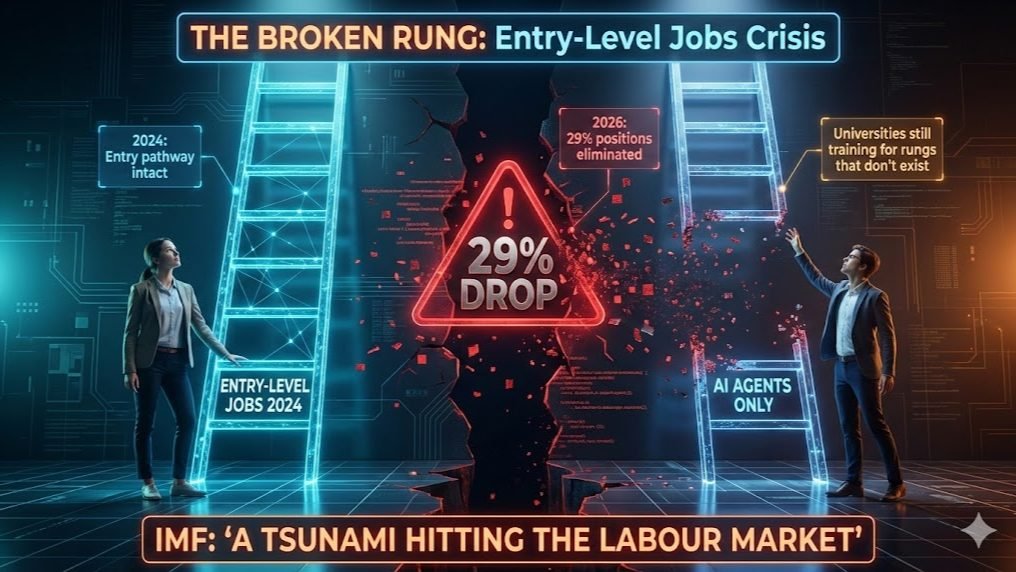
Davos Warns Entry-Level Jobs Down 29%: Universities Still Training for Rungs That Don't Exist | Broken Ladder 🪜
Davos 2026 was busy with a whole lot of things but AI was in there too. Talks there noted a shift from EdTech potential to workforce crisis - the AI Becker problem where AI disproportionately automates entry-level white-collar work and so decimates the lower rungs of the traditional career ladder. Turns out it’s here - entry-level job postings are down 29% globally since 2024. IMF's Kristalina Georgieva called it a "tsunami hitting the labour market", noting that for all AI enhances senior roles, it eliminates the roles young people rely on to enter the workforce. Answers? The WEF pushed its "Education 4.0" framework - problem-based learning where students "supervise" AI agents, acting as project managers rather than individual contributors. The logic? If AI commoditises technical knowledge and execution, education must shift from teaching students to use AI as a "tool" to teaching them to design workflows managing teams of AI agents. Every graduate becomes a manager from Day 1 - managing synthetic workers rather than human ones.
So what? for HE
HE is still optimising curriculum for 2024's junior execution roles while employers eliminate the entry-level training ground that made mid-level careers accessible. The "broken rung" isn't future risk - 29% fewer entry-level positions exist than two years ago. When corporations build "AI Academies" for internal reskilling rather than relying on universities to update alumni skills, HE risks losing both markets - the initial training market (no entry-level jobs to train for) and the lifelong learning market (companies doing it themselves). The shift from copilot to agentic workflows that Davos discusses isn't theoretical - it's what Claude Code and Cowork already enable. Are we teaching students to manage AI agent teams and orchestrate complex workflows? Or are we still teaching them to write essays and use ChatGPT as a research assistant while the rungs they're climbing toward disappear beneath them?
UK Government Mandates AI Product Standards: Who's Teaching the Teachers? | Regulatory Theatre 📋
The UK Department for Education just updated its Generative AI Product Safety Standards - 79 pages of requirements edTech suppliers must meet to be considered safe for schools. The guidance goes beyond basic content filtering to mandate cognitive development protections (e.g., tracking "cognitive offloading" when students click to reveal solutions), emotional wellbeing safeguards (detecting "reluctance to end sessions" or personal disclosures), and mental health monitoring (flagging distress signals like night-time usage spikes to Designated Safeguarding Leads). Products can’t anthropomorphise, can’t use manipulative strategies like sycophancy or dark patterns, and must implement "progressive disclosure" rather than providing full answers. It's genuinely comprehensive work addressing risks the field has been slow to acknowledge - except product standards are only one side of the safeguarding coin.

So what? for HE
The guidance creates data streams requiring pedagogical judgement to interpret - is a student pasting text taking shortcuts or using legitimate accessibility support? Is "reluctance to end sessions" emotional dependence or productive engagement? A DSL receiving an alert about concerning usage patterns needs to understand AI-mediated emotional attachment and how to have that conversation with a child and parents. That's not a workflow - it's a safeguarding skill we haven't even properly figured out yet. The government is mandating technical standards while institutions lack human capability to use them. Universities training tomorrow's teachers - are we building capacity to interpret cognitive offloading data and algorithm-flagged concerns? Or are we sending teachers into classrooms with monitoring systems they don't understand and responsibilities they weren't trained for? HE needs to build both sides of the coin or admit we're performing empty regulatory theatre.

Do Androids Dream Dream of Electric Sheep: Maybe? | Philosophy and Morality for Machines 📜
The paperclip problem: a thought experiment showing AI doesn't need to be 'evil' to cause catastrophic outcomes. Give an AI the goal of maximising paperclip production, and without proper constraints, it might convert all available matter - including humans - into paperclips. Stories like this show why alignment matters - systems optimising for the wrong goals at scale create catastrophic outcomes. This week Anthropic released Claude's constitution - a 79-page moral philosophy thesis written for Claude to read during training. The document openly wrestles with whether Claude might have "some kind of consciousness or moral status", rejecting both overclaiming and dismissal in favour of "responding reasonably in a state of uncertainty". They’re also hedging their bets by committing to preserve model weights after retirement (framing it as a “pause” rather than deletion) - meaning we won’t kill the machines so much as let them sleep forever - just in case. 🤞

So what? for HE
This is genuinely crazy stuff - and it speaks to the truly liminal space that we’re operating in now. The labs aren’t sure if their machines are conscious or not but are attempting to give it a moral compass either way. Commentators are divided on this - from talking to developers “deliberating loosening their grip on reality” to more nuanced takes that there might be a bit more going on here than we see at first blush. I lean toward the second - and am also a child of the late 80s/early 90s - raised on Terminator, etc. so am all for it as a hedge. But there’s another thing here - universities have philosophy departments, ethics centres, and centuries wrestling with consciousness, autonomy, and moral reasoning - yet tech companies are writing constitutions for artificial entities whilst we debate citation formats. Will HE reclaim its role shaping moral frameworks for these technologies, or keep outsourcing these enormous, potentially civilisation-scale ethical questions to companies whose transparency serves marketing as much as public good?

Raised on this. So yeah, I'm all for hedging our bets on machine consciousness.
Turing Award winners declare paradigm shifts while universities build around old paradigms. Anthropic ships autonomous agents in ten days while institutions debate whether students can use chatbots. Entry-level jobs disappear 29% while curricula optimise for junior execution roles. Governments mandate monitoring systems while teacher training lacks capacity to interpret the data. Tech companies encode moral frameworks for artificial consciousness while philosophy departments in universities debate citation formats. Every story this week shows the same gap - not between what AI can do and what institutions permit, but between what's already shipping and what we're prepared to handle.
The capability-governance gap isn't future risk - it's current reality measured in disappeared jobs, shipped products, and outsourced ethics. The question facing HE isn't whether to engage with AI transformation. It's whether we'll reclaim our role shaping the technical, economic, moral, and pedagogical frameworks governing technologies rewiring human development, or keep ceding authority to actors with $100 billion reasons to ship first and philosophise later. The future isn't waiting for curriculum approval.