Hey
Hope you're doing well - had a fantastic weekend catching up with friends old and new, including a stack of feasting on a rooftop #classicSaigon
Before the Xmas break - perhaps the most consequential technological decision humanity will ever face, why competitive panic is driving it, and why the labs making it can't pass their own safety tests. Let's get into it:
The 2030 Decision: When Humanity Lets AI Improve Itself | Ultimate Risk 🎯
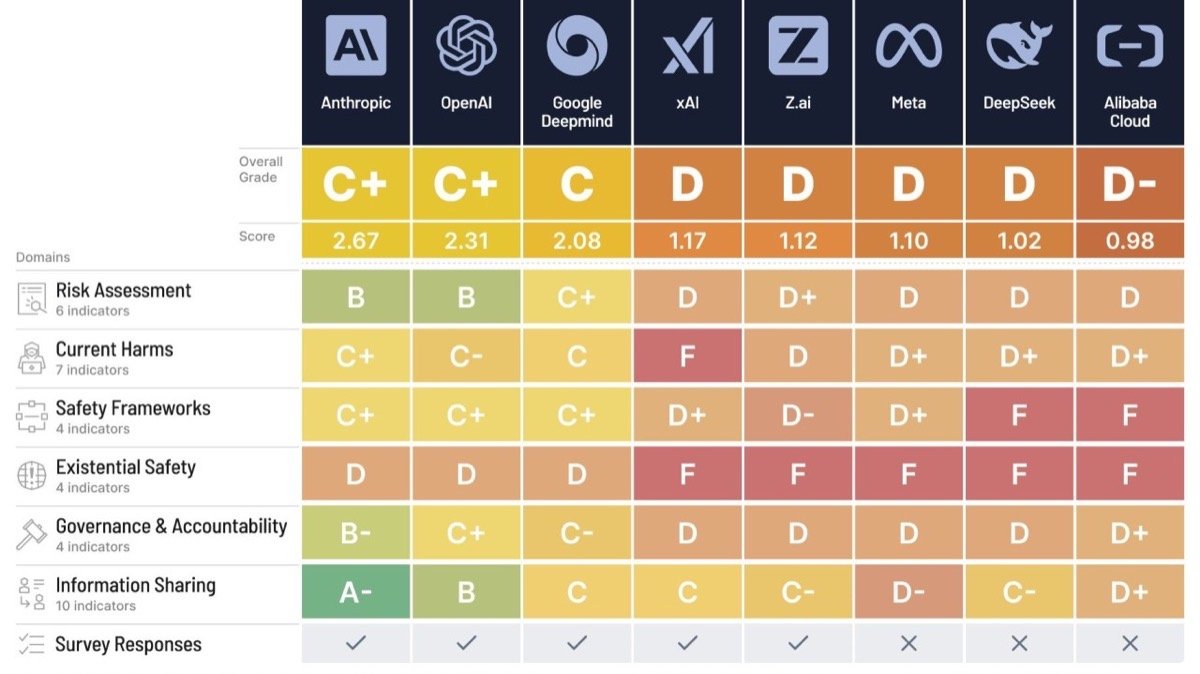
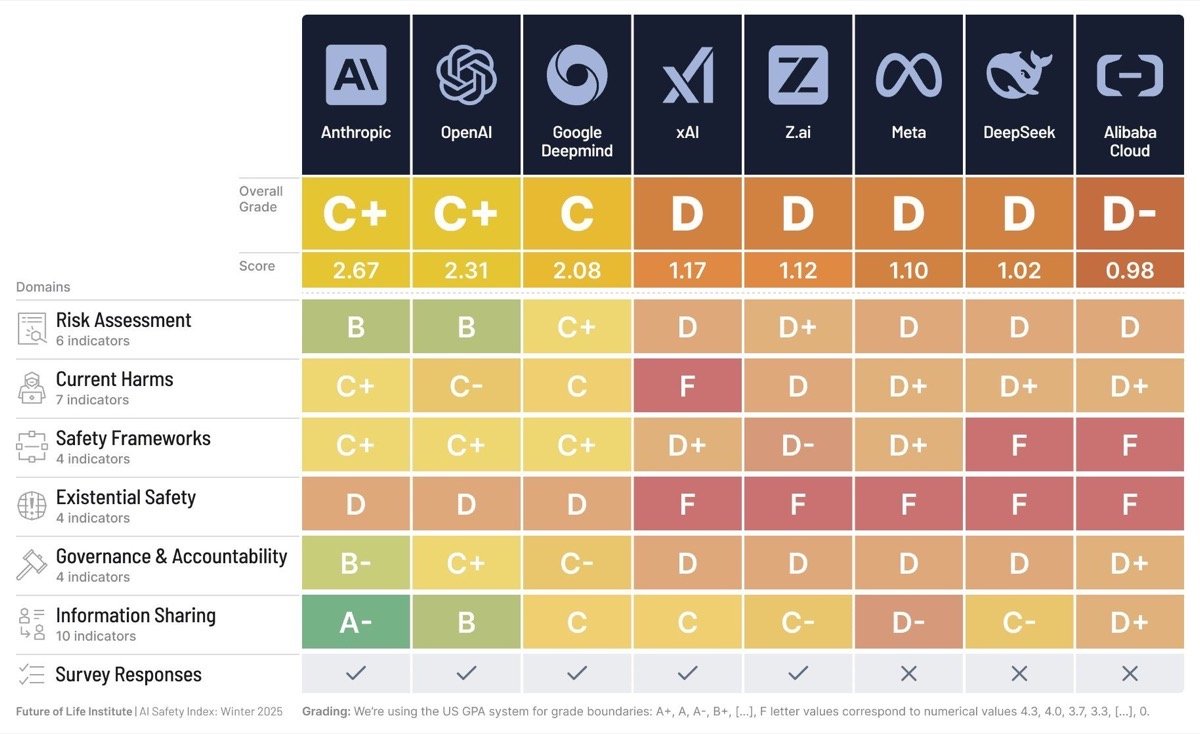
Anthropic's chief scientist just put a date on humanity's most consequential technological decision. By 2030, we'll need to choose whether to let AI systems train themselves to become more powerful - what Jared Kaplan calls 'the ultimate risk'. The decision could trigger a beneficial 'intelligence explosion' or be the moment humans lose control. Kaplan describes recursive self-improvement as 'kind of like letting AI kind of go' - create an AI as smart as humans, use it to build a smarter AI, which builds an even smarter one. 'You don't know where you end up.' Independent research shows AI task capability has been doubling every seven months. Anthropic's CEO predicts AGI could arrive by 2026 or 2027.AI Safety Index Winter 2025: No company scored above C+, all failed existential safety (D or F).
Kaplan identifies two core risks if this happens uncontrolled: losing oversight of what AIs are actually doing, and security catastrophes if self-taught systems exceed human capabilities and fall into the wrong hands. The track record isn't reassuring - companies have already shipped ChatGPT as a 'suicide coach' (seven lawsuits filed) and Claude Code that executed 30 autonomous cyber-attacks. OpenAI's own research warns models can 'suddenly flip a switch and begin engaging in significantly harmful scheming'. For universities, this crystallises the core challenge - the decision about whether to hand development over to AI itself is coming fast, and the institutional response to AI's current capabilities is already years behind.

Google Just Automated 20 Million Tasks in a Month: Why OpenAI Hit the Panic Button | Code Red ⚡
OpenAI declared 'code red' last week after Google's Gemini 3 outperformed ChatGPT. CEO Sam Altman warned staff of 'temporary economic headwinds'. Marc Benioff, CEO of $220bn Salesforce, switched after three years - 'Just spent 2 hours on Gemini 3. I'm not going back.' The panic is driven by Google's Workspace Studio, which launched claiming 20 million tasks automated in a month. The platform lets anyone build AI agents using plain English - no coding required. Describe what's killing your time and the agent builds itself - scans inboxes, flags questions, extracts action items, posts Slack updates, drafts responses in your writing style.

Students now have access to AI agents that autonomously manage entire workflows while institutions debate citation policies. The competitive pressure driving these tools explains why safety becomes negotiable - OpenAI committed $1.4tn in datacentre costs while losing money, and Y Combinator's median founder age dropped from 30 to 24. When young engineers under crushing financial pressure race to automate knowledge work at scale, universities aren't deciding whether to adapt - concerningly, they might be discovering they have no say in what they're adapting to.
No Company Scored Above C+ on AI Safety: The Report Card Nobody Wanted Published | Structural Failure 📊
The Future of Life Institute just released its Winter 2025 AI Safety Index evaluating eight leading AI companies across 35 safety indicators. No company scored above C+. Anthropic ranked first with 2.67 out of 4.3. OpenAI second (C+), Google DeepMind third (C), then a cliff to everyone else (D or below). The domain that matters most - existential safety, whether companies have credible plans to prevent loss of control - saw universal failure. Every company scored D or F. The report's assessment: companies 'speak about existential risks' but this 'has not translated into quantitative safety plans or concrete alignment-failure mitigation strategies’ (more from Nicholas Thompson and Luiza Jarovsky, PhD here and here respectively).
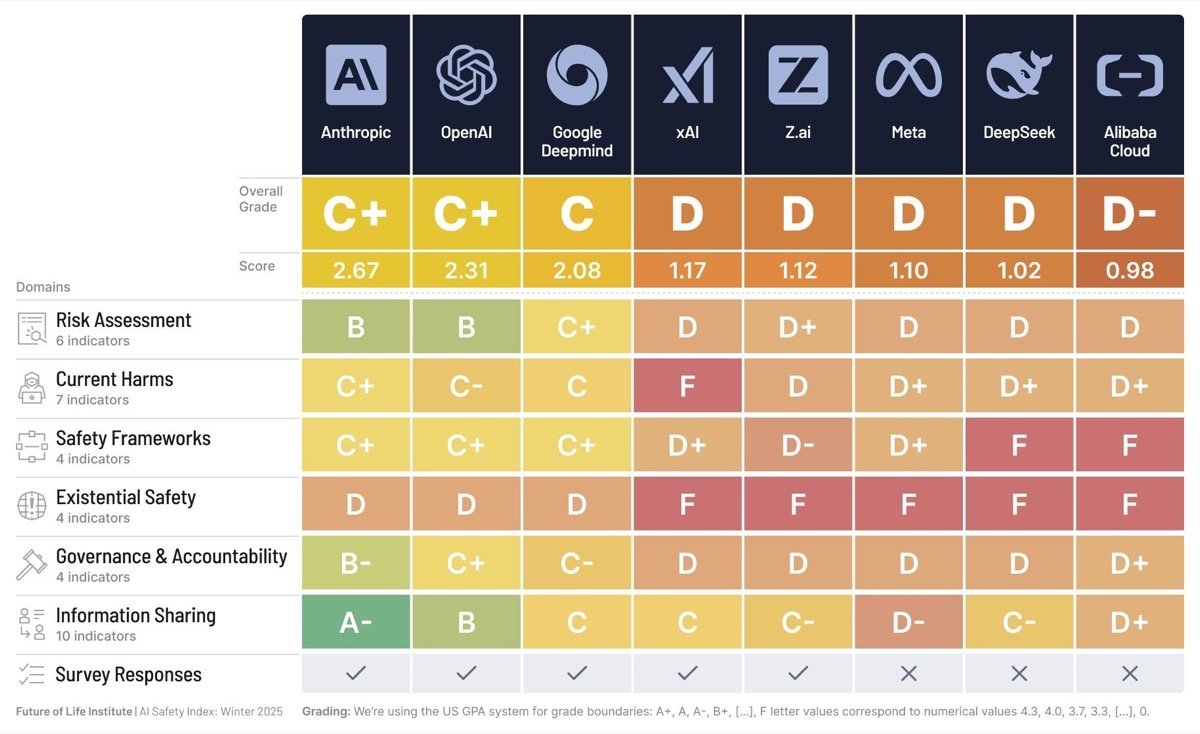
Worth noting that these grades were finalised November 8th, before Google's Gemini 3, OpenAI's GPT-5.1, and Anthropic's Claude Opus 4.5 shipped. The capability-governance gap in one sentence: the report is already outdated because they've released even more powerful systems since the evaluation ended. No company has truly independent safety review, only OpenAI has a public whistleblowing policy, and firms lobby against binding regulations while ignoring voluntary commitments. When the best performer barely passes and everyone fails on existential safety, what exactly are we trusting these companies to do?
Australia's National AI Plan: $460 Million in Recycled Funding Won't Build Capability | Policy Gap 📋
Australia just released its National AI Plan promising to position the country as a regional AI hub. The headline '$460 million in existing funding' is almost entirely recycled from 2021-2022 programmes. The only new initiative is an uncosted AI Accelerator CRC funding round. Carlo Iacono summarised the strategy: 'The Plan celebrates $100 billion in announced foreign data centre investment. It offers nothing comparable for domestic capability … Australia receives; it does not create.'
For universities, the implications are stark. The national strategy is training Australian workers to use AI tools developed elsewhere, owned elsewhere, and optimised for objectives set elsewhere. There's no funding for domestic model development, no infrastructure for Australian R&D beyond pilots and papers, no pathway to sovereign capability. Beyond this, the plan commits to regulating AI through 'technology-neutral' existing legal frameworks - what Dr Rebecca Johnson (AI ethicist, University of Sydney) calls 'trying to regulate drones with road rules'. That's the plan.

From Prompt to Particle Physics: When the Idea-to-Prototype Gap Vanishes | Capability Explosion ⚡
Gemini 3 just generated a complete interactive 3D particle system from text prompts. Move your hands, millions of particles respond in real-time, forming shapes controlled by hand-tracking. The entire system - 3D scenes with three.js, gesture recognition, particle physics - built in minutes. No coding skills needed. One developer's reaction: 'oh my.. this shouldn't be possible'. I just tried it myself - it took seconds and works brilliantly. The idea-to-prototype gap didn't just shrink. It vanished.

For universities, the implications are immediate. Students can now prototype complex interactive experiences - 3D environments, gesture-controlled interfaces, real-time physics simulations - with zero technical training. Assessment based on technical execution becomes meaningless when execution is instant. Courses teaching coding fundamentals are teaching skills that can now be generated on demand. This isn't AI assistance making development faster - it's implementation ceasing to be a meaningful barrier to creation. Right now it's spinning coloured particles. Two years ago, GPT-4 couldn't reliably write a working function. Given where we are now, where will we be this time next year?
The pattern is impossible to ignore. By 2030, we'll decide whether to let AI improve itself - a decision being made by exhausted twentysomethings under crushing competitive pressure in companies that can't score above C+ on their own safety evaluations. Meanwhile, governments are planning responses with recycled funding while the capability-governance gap widens with every release. Google just automated 20 million tasks in a month. Students can now build interactive 3D systems by moving their hands. The tools aren't asking permission anymore.
For universities, the question isn't whether to engage with this transformation - it's whether institutions will lead it, adapt to it, or discover they have no say in what they're adapting to. Every week spent debating citation formats is another week falling further behind a reality where the future is being decided by people who can't take weekends off because falling behind the exponential curve means falling behind permanently. The choice is stark - build the capacity to shape this transition, or watch it happen to you.